The global phenomenon of K-pop has always been driven by one distinct, undeniable force: the unparalleled dedication of its fandoms. For decades, the relationship between K-pop idols and their fans was defined by immense, highly organized collective action. Fans were not merely passive consumers of music; they functioned as unpaid marketing departments, PR agencies, and most notably, highly disciplined streaming armies. This era was characterized by the culture of “chong-gong” (a Korean abbreviation for “general attack” or “total assault”), where dedicated fan bases meticulously coordinated mass streaming and bulk purchasing to force their favorite artists to the top of domestic music charts like Melon, as well as international rankings like the Billboard Hot 100. It was a numbers game, dominated by those who could organize the most funds, deploy the most devices, and stay awake through the night to ensure continuous, unbroken streaming loops.
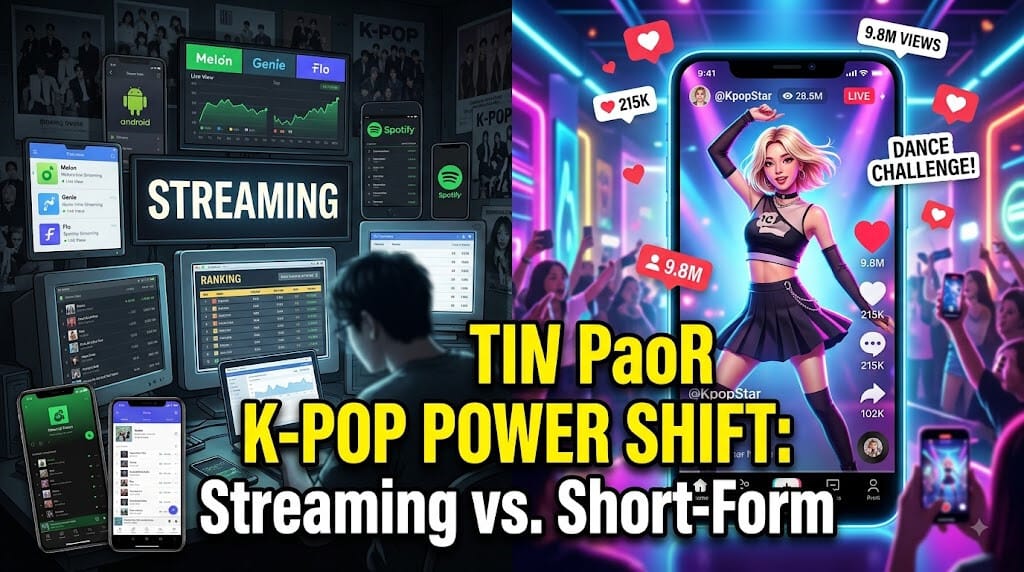
However, over the last few years, a massive generational and cultural shift has completely disrupted this traditional K-pop power structure. The relentless, exhausting campaigns of mass streaming are slowly giving way to a much more decentralized, organic, and unpredictable force: the short-form video challenge. Platforms like TikTok, Instagram Reels, and YouTube Shorts have fundamentally altered how music is discovered, consumed, and popularized. Today, a viral 15-second dance challenge or a catchy “sped-up” audio clip holds more power to dictate chart success than a highly organized fan union with thousands of dollars at its disposal. This transition from “chong-gong” to short-form virality represents more than just a change in marketing tactics; it signifies a massive power shift in the K-pop industry, transferring influence from the hardcore, organized fandoms to the casual, algorithm-surfing global public.
The Anatomy of “Chong-gong”: The Era of Organized Mass Streaming
The Military Precision of Fan Unions
To truly understand the magnitude of this power shift, one must first understand the sheer scale of the “chong-gong” culture that dominated the second and third generations of K-pop. “Chong-gong” was not casual listening. It was an orchestrated, military-style operation. Fandoms formed dedicated task forces, often referred to as “streaming unions” or “총공팀” (Chong-gong teams). These teams would gather donations from global fans, creating massive financial pools. This money was then used to purchase hundreds of premium streaming passes on Korean platforms like Melon, Genie, and Bugs.
Organizers would create highly specific “streaming manuals.” These manuals dictated the exact order of songs to be placed in a playlist to avoid triggering algorithmic spam filters. Fans were instructed to clear their caches, log in from multiple devices, use VPNs if they were international, and stream 24 hours a day. The ultimate goal was the “zombie streaming” hours—the late-night period between 1:00 AM and 7:00 AM when the general public was asleep. By mobilizing during these hours, fandoms could easily manipulate the real-time charts, pushing an idol’s new release to the prestigious “All-Kill” #1 spot, securing music show wins and media headlines the next morning.
The Impact on Global Markets and Billboard
This hyper-organized culture did not stay confined to South Korea. As K-pop expanded globally, international fandoms adopted the chong-gong methodology to infiltrate the most prestigious music charts in the world, most notably the Billboard charts in the United States. Fans organized complex “buying parties,” strategically timing digital single downloads on iTunes and coordinating Spotify streaming playlists to maximize chart points.
This collective action was instrumental in breaking K-pop into the Western mainstream. It proved that K-pop had a guaranteed, massive baseline of support. However, it also created a stark divide between “fandom popularity” and “public popularity.” An artist could debut at #1 on the Billboard Hot 100 purely based on massive, fan-funded digital sales and organized streaming, even if the general public had never heard the song on the radio or in their daily lives.
The Tipping Point: Chart Reforms and Algorithmic Awakening
Domestic Reforms: Defending Against Zombie Streaming
The dominance of chong-gong eventually reached a breaking point, prompting major platforms to fight back. In South Korea, the general public grew increasingly frustrated with music charts that no longer reflected actual popular trends, but rather just mirrored the size and wealth of idol fandoms. In response, Korea’s largest streaming platform, Melon, underwent a massive reform in 2020. They abolished the real-time chart, which was easily manipulated by midnight streaming, and replaced it with the “24Hits” chart, which calculated rankings based on unique listeners over a 24-hour period.
This seemingly simple algorithmic change was a devastating blow to the chong-gong culture. It meant that one dedicated fan streaming a song 100 times in a day only counted as one point. To reach #1, a song actually had to be listened to by millions of different, ordinary people. The power to dictate the charts was forcibly taken out of the hands of the organized fan unions.
Billboard’s Evolving Metrics
A similar awakening happened globally. Billboard recognized that mass digital purchasing by organized fanbases was distorting the reality of what songs were genuinely popular. In 2022, Billboard changed its rules regarding digital downloads, ruling that bulk purchases of the same track by a single customer would no longer be counted toward chart rankings. With these structural defenses put in place by major charting institutions, the era of buying and brute-forcing a song to the top was effectively over. A vacuum was created, and the K-pop industry desperately needed a new formula for success.
The Short-Form Takeover: TikTok, Reels, and the New Viral Economy
Zico and the Birth of the “Challenge” Culture
Nature abhors a vacuum, and the K-pop industry found its new kingmaker in the form of TikTok. The pivotal moment occurred in early 2020 with the release of Zico’s “Any Song.” Instead of relying on a massive fandom to stream the song, Zico launched the “Any Song Challenge” on TikTok. He posted a video of himself doing a simple, catchy, and easy-to-follow upper-body dance with other celebrities.
The strategy was a masterstroke. It didn’t require fans to spend money or stream on loop; it simply invited people to participate. The challenge went unfathomably viral. Teenagers, influencers, and casual listeners who had no interest in K-pop fandom culture began participating in the challenge. “Any Song” dominated the Korean charts for months, relying almost entirely on organic virality rather than organized chong-gong. This moment fundamentally rewired the brain of the K-pop industry.
Sped-Up Remixes and the Power of the Casual Listener
Today, short-form platforms like TikTok, Instagram Reels, and YouTube Shorts dictate global music trends. It is no longer about how many dedicated fans you have; it is about how algorithmically “sticky” your 15-second audio clip is. The success of FIFTY FIFTY’s “Cupid” is the ultimate testament to this power shift. FIFTY FIFTY came from a small, relatively unknown agency and had a very small established fandom. They could never have organized a chong-gong campaign to rival the big agencies.
However, a “sped-up” version of “Cupid” created by an anonymous user went viral on TikTok. It became the background music for millions of makeup tutorials, daily vlogs, and meme videos. The song skyrocketed up the Billboard Hot 100 and Spotify Global charts, driven entirely by casual listeners and short-form creators. The traditional K-pop playbook was completely bypassed.
The Generational Power Shift in K-Pop Consumption
Decentralization of Fandom Power
This transition marks a massive decentralization of power within the K-pop ecosystem. In the past, the “Fan Union President” or the head administrators of large fan forums held immense power. They directed the flow of thousands of dollars and dictated the daily activities of millions of fans. If an agency angered the core fandom, they risked losing their primary source of chart success and revenue.
Now, that power has dispersed into the hands of random, decentralized creators. A 16-year-old TikTok user in Brazil who creates a viral transition video using a K-pop song holds more promotional power than a coordinated streaming team in Seoul. Entertainment agencies are no longer just catering to the hardcore “stans” who buy 50 copies of an album; they are desperately trying to court the casual, swiping thumbs of the global youth.
Easy Listening and the “Magnetic” Effect
This power shift has heavily influenced the musical direction of the 4th and 5th generations of K-pop. We are witnessing a stark move away from loud, aggressive, highly complex tracks designed strictly for intense performance. Instead, groups like NewJeans and ILLIT are dominating with “Easy Listening” music. ILLIT’s debut track “Magnetic” became a global sensation almost instantly. Why? Because the song is inherently designed for short-form consumption. It features a relentless, catchy hook, soothing vocals, and an incredibly simple, repetitive hand choreography that anyone can mimic in front of their smartphone camera.
How K-Pop Agencies Are Rewriting Their Playbooks
Choreographing for the Camera Frame
The short-form revolution has altered every aspect of K-pop production, starting with choreography. Historically, K-pop dances were complex, full-body routines meant to be viewed on a large stage or a wide-angle music video. Today, choreographers are explicitly instructed to focus on “point choreo” that primarily uses the hands, arms, and upper body. The dance must look good within the restrictive 9:16 vertical aspect ratio of a smartphone screen. If a dance cannot be easily replicated by a non-dancer in their bedroom for a TikTok challenge, it is considered a marketing failure.
The Death of the Three-Minute Song
Furthermore, song structures are shrinking. To cater to the dwindling attention spans of short-form users, K-pop songs are becoming shorter. Intros are practically non-existent, and songs often jump straight into the chorus within the first 10 seconds to hook the listener before they swipe away. The traditional bridge and final dance break are frequently being scrapped to keep songs comfortably under the two-and-a-half-minute mark. This structural change ensures that songs are easily loopable, increasing organic streaming numbers driven by casual enjoyment rather than forced, organized labor. The era of the exhausting chong-gong is fading, replaced by an era where the ultimate goal is not to conquer the chart through force, but to simply become the internet’s favorite background music.
Writer’s Opinion
You know, thinking about all this… isn’t it actually kind of crazy how much things have changed? I mean, I remember the days when fans would literally have five phones lined up on their desks, staying up until 4 AM just to stream a song so their bias wouldn’t drop in the rankings. That was true dedication, but honestly… it sounded exhausting, right? Now, you have a random kid doing a 10-second hand dance on TikTok, and suddenly a rookie group is charting on Billboard without even trying! It really makes you wonder who holds the real power now. Is it the loyal fan who buys 100 albums, or the random scroller who accidentally makes a song go viral? AI and algorithms are essentially the new ‘fan union presidents’—which is brilliant but also a little bit scary, don’t you think? Either way, I’m just glad the music is getting easier to listen to!