
The global dominance of the K-pop industry is no longer just measured by billions of streams on Spotify or YouTube views; it is fundamentally anchored in a highly lucrative, physically distributed product empire. When a fan in New York, Paris, or São Paulo unboxes a newly released album, they are participating in one of the most fascinating and high-margin retail ecosystems in modern entertainment. The K-pop merchandise (MD) market has evolved from simple fan club t-shirts to a sophisticated array of products, acting as a massive revenue pillar for entertainment companies. At the heart of this economic powerhouse are two distinct yet iconic items: the humble photocard and the technologically advanced lightstick.
Understanding how these items travel from a manufacturing plant to an overseas fan’s hands requires a deep dive into the complex web of global logistics, intellectual property valuation, and psychological pricing. The journey of these goods is a masterclass in modern supply chain management, balancing incredibly low production costs with premium retail pricing driven by emotional attachment. By dissecting the supply chain economics of K-pop merchandise, we can uncover the astonishing cost ratios and the intricate global distribution networks that allow entertainment agencies to achieve profit margins that traditional retail sectors could only dream of.
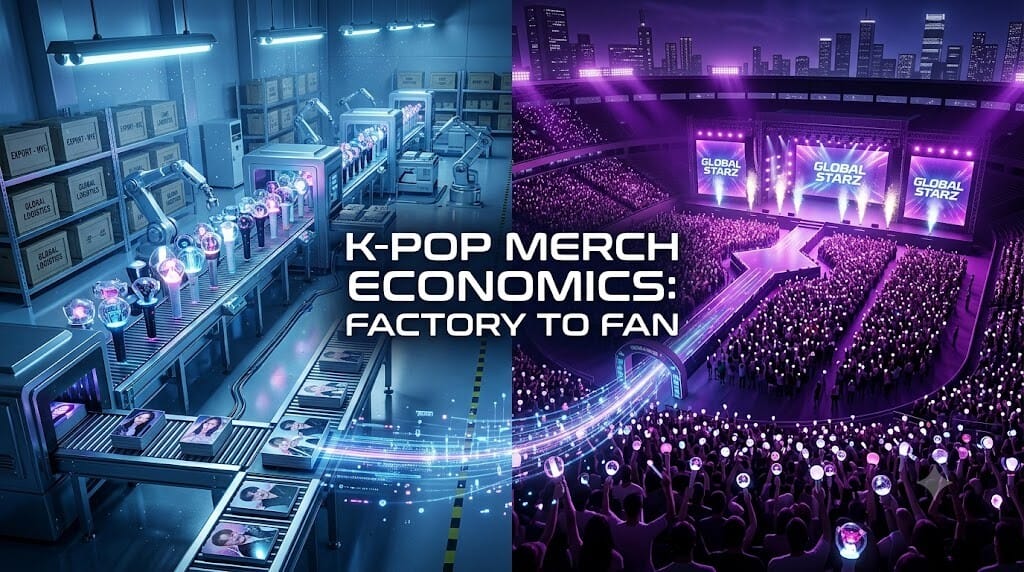
The Phenomenon of Merchandise Economics
The entertainment merchandise sector operates on a fundamentally different economic model compared to traditional consumer goods. While standard retail relies on utility and competitive pricing, K-pop MD is driven by emotional resonance, scarcity, and community identity. This unique market dynamic allows for premium pricing structures that completely detach the retail price from the underlying cost of goods sold (COGS).
The Humble Photocard: A High-Margin Miracle
The photocard is perhaps the most economically fascinating product in the modern music industry. Physically, it is nothing more than a 55mm by 85mm piece of glossy cardstock, printed with high-resolution imagery and sometimes coated with a holographic finish. The manufacturing cost of a single photocard, when produced in massive bulk, is fractions of a cent. Yet, its perceived value is astronomical.
Because photocards are often randomized within albums or sold in sealed “lucky draw” packs, they introduce a gacha-style mechanic to physical retail. Fans frequently purchase multiple copies of the same album—sometimes dozens or hundreds—just to secure a specific member’s photocard. This drives the effective retail value of that small piece of paper into the tens or even hundreds of dollars on the secondary market. From a supply chain perspective, the photocard represents the ultimate low-weight, low-volume, ultra-high-margin product. It requires minimal warehousing space, costs almost nothing to ship, and generates massive revenue multipliers for the parent company.
Lightsticks: The Technological Core of Fan Identity
In stark contrast to the simple photocard, the concert lightstick is a complex electronic device that serves as the technological and visual core of a fandom’s identity. Modern lightsticks are equipped with Bluetooth modules, RGB LEDs, microcontrollers, and custom-molded plastic housings designed to reflect the specific lore or branding of the artist.
Unlike photocards, lightsticks require a sophisticated manufacturing supply chain involving electronics procurement, plastic injection molding, and software integration. During concerts, these devices are synced to a central control booth via Bluetooth, creating synchronized oceans of light. Despite the higher production costs compared to paper goods, the profit margins remain staggering. A lightstick that costs a few dollars to manufacture and assemble in a factory can easily retail for fifty to seventy dollars.
The Global Logistics Journey: Factory to Fan
The journey of K-pop merchandise from raw materials to a fan’s glowing concert experience involves a multi-node global logistics network. This supply chain must be incredibly agile, as demand often spikes violently around comeback schedules, album releases, and world tours.
Manufacturing Nodes in East Asia
The first step in the merchandise supply chain begins in the manufacturing hubs of East Asia. While the intellectual property, design, and branding are tightly controlled by entertainment agencies in Seoul, the actual physical production is heavily outsourced.
For electronics like lightsticks, manufacturing is predominantly located in tech-heavy regions such as Shenzhen, China. Here, factories handle the injection molding of the custom acrylic and ABS plastics, source the LED and Bluetooth components, and manage the final assembly. For printed goods like photocards, photobooks, and posters, production often remains in South Korea to ensure strict quality control over image reproduction and to prevent unauthorized leaks of unreleased concept photos. These factories operate under intense non-disclosure agreements (NDAs) due to the highly secretive nature of K-pop release schedules.
The Distribution Bottleneck: Warehousing and Sorting
Once the goods are manufactured, they are transported to massive fulfillment centers, primarily located in South Korea. This stage is often the bottleneck in the K-pop supply chain. Because merchandise drops are highly centralized—often sold exclusively through proprietary apps like Weverse Shop or specialized retailers—these fulfillment centers experience massive, concentrated volume spikes.
During a major artist’s comeback, millions of albums and merchandise items must be sorted, packed, and labeled within a matter of days. The logistics here involve complex kitting processes, especially when randomized items like photocards must be inserted into pre-orders. To handle international demand, these warehouses act as global distribution hubs, utilizing advanced warehouse management systems (WMS) to coordinate freight forwarding via air and sea.
Last-Mile Delivery to Global Fans
The final leg of the journey is the most expensive and complex: cross-border shipping and last-mile delivery to international fans. When a fan in Europe or the Americas orders a lightstick, the package is usually handed off to major international couriers (like DHL, FedEx, or EMS).
The logistics economics here are heavily influenced by volumetric weight. A lightstick comes in a bulky, protective presentation box. While the item itself is relatively light, the large box takes up significant space in an aircraft cargo hold, leading to high shipping fees. Fans often pay shipping costs that equal or exceed the price of the merchandise itself. Furthermore, these goods must clear international customs, where they are subject to import duties and VAT, adding another layer of complexity to the global distribution model.
Cost Breakdown and Profit Margins in K-Pop Merch
To truly understand the supply chain economics, we must look at the estimated cost ratios. The entertainment industry’s financial success is heavily reliant on the massive discrepancy between the production cost and the final retail price.
Production Cost vs. Retail Price
The traditional retail model aims for a gross margin of around 40% to 50%. The K-pop merchandise model shatters these benchmarks.
- Photocards & Paper Goods: The manufacturing cost is virtually negligible, often estimated at less than $0.05 per card. When bundled into an album or sold in a merchandise pack for $15 to $25, the gross margin approaches 99%.
- Lightsticks: The estimated Bill of Materials (BOM) for a standard Bluetooth-enabled lightstick, including the plastic mold, PCB, LEDs, and packaging, typically ranges from $5 to $9 depending on volume. With retail prices set between $50 and $65, the gross margin sits comfortably above 80%.
- Apparel (Hoodies, T-Shirts): A mass-produced branded hoodie might cost $8 to $12 to manufacture in Southeast Asia. Retail prices at concert venues easily reach $70 to $90, yielding margins similar to high-end luxury fashion brands.
Hidden Costs: Licensing, Marketing, and IP
While the physical production costs are low, the economics must also account for the hidden costs associated with intellectual property. The value of the merchandise is entirely derived from the artist’s brand equity, which costs millions of dollars to build through music videos, training, marketing, and promotions. The supply chain is essentially monetizing the intangible asset of fandom. Therefore, a portion of the high profit margin is used to subsidize the immensely expensive process of idol group development and global marketing campaigns.
The Future of the K-Pop Merchandise Supply Chain
As the global fan base continues to expand, entertainment companies are actively working to optimize their supply chains to capture even more value. We are seeing a shift towards localized production and distribution. Instead of shipping every lightstick from Seoul to Los Angeles, agencies are establishing regional fulfillment centers in North America and Europe. This strategy drastically reduces cross-border shipping costs and delivery times, lowering the barrier to entry for international fans and increasing overall sales volume.
Additionally, the integration of digital supply chains is becoming more prevalent. The rise of digital photocards (NFTs) and virtual merchandise for metaverse concerts represents a supply chain with zero physical manufacturing costs, zero shipping, and instant global delivery. However, the physical, tactile nature of merchandise—the joy of unboxing, the weight of a lightstick at a concert—remains irreplaceable. The global logistics network, despite its complexities and costs, will continue to be the vital artery that connects global fans to the artists they love, proving that in the economy of fandom, emotional value will always outprice manufacturing reality.
Writer’s Opinion
You know, looking at the three lightsticks sitting on my desk right now, it just hits me—are we seriously paying almost sixty bucks for some molded plastic and a tiny Bluetooth chip? I mean… thinking about those crazy 80% profit margins and the fractions of a cent it takes to print a piece of paper, my wallet kind of wants to cry. But then again, when the arena goes totally dark and suddenly thousands of those plastic sticks light up in perfect sync to the music… isn’t that just absolutely mind-blowing? It really makes me wonder if we are buying a physical item at all, or just paying the admission fee to feel like we belong to something bigger than ourselves. I guess logic and supply chain economics just go out the window when your favorite song starts playing, huh?