The music industry is undergoing a seismic shift with the rapid evolution of generative AI. Today, artificial intelligence can compose entire tracks, generate royalty-free background music, and even mimic specific vocal styles from a simple text prompt. For creators seeking quick and mathematically perfect audio, these algorithms offer unprecedented convenience. AI models have ingested centuries of musical theory, learning the fundamental chord progressions, rhythmic structures, and pop formulas that dominate global charts. However, as this technology becomes more ubiquitous, producers, artists, and listeners alike are beginning to notice a glaring plateau in its creative capabilities.
Nowhere are these technological limitations more exposed than in the vibrant, hyper-dynamic world of K-pop. South Korean pop music has captivated a massive global audience not just through its visual spectacle, but through an incredibly complex, intentionally chaotic approach to audio production. K-pop actively defies traditional western songwriting formulas, opting instead to aggressively blend contrasting genres and constantly subvert listener expectations. This brings us to a highly debated question in modern production rooms: Can generative AI, a system fundamentally built on predicting the safest statistical patterns, truly replicate the deliberate “irregular variations” and “cliché twists” that define K-pop? Let’s explore the critical blind spots of algorithmic composition.
The Mechanics of AI Music Composition
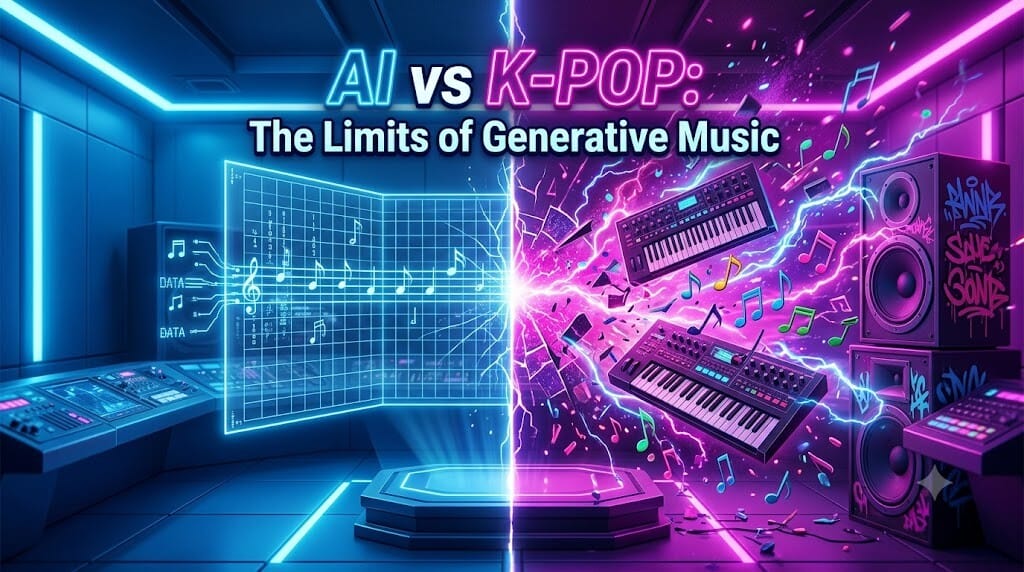
To understand why artificial intelligence struggles with highly stylized genres, we must first look at how these systems generate audio. Generative AI tools are built entirely upon predictive mathematical modeling. They analyze millions of existing songs to determine the statistical probability of which note, beat, or chord should logically follow the previous one.
Predictive Modeling and Safe Harmony
Because AI learns from historical musical data, its primary objective is to generate an output that is cohesive, inoffensive, and harmonically correct. It heavily relies on the standard, highly predictable verse-chorus-verse structure. The algorithm is literally programmed to avoid dissonance and minimize mathematical errors. The result is music that is highly pleasant to the ear but often entirely predictable. It creates the ultimate “safe” track, devoid of any real tension.
K-Pop’s Core Philosophy: Controlled Chaos
K-pop, as a genre, completely rejects the concept of playing it safe. Unlike traditional pop music, which relies on a repetitive and soothing flow to keep listeners passively engaged, K-pop is designed to be a musical rollercoaster. It actively demands the listener’s attention by constantly shifting gears and creating friction.
The Power of Irregular Variations
A defining characteristic of modern K-pop is its structural unpredictability—often referred to as “mixx pop” or hybrid-genre production. It is highly common for a single K-pop song to begin as a cheerful bubblegum pop anthem, suddenly drop into a heavy trap rap verse, transition smoothly into a soulful R&B bridge, and then explode into an abrasive EDM chorus. These sudden, irregular variations are entirely deliberate. Human producers intuitively know exactly how to push the boundaries of musical dissonance without entirely losing the underlying groove. AI, seeking harmony, views these sudden shifts as “errors” to be corrected.
The Ultimate Blind Spot: Twisting the Cliché
Beyond just mashing genres together, K-pop relies heavily on the psychological manipulation of the listener. Producers use deeply ingrained musical tropes specifically to trick the audience.
Why Algorithms Fail at Rebellious Art
K-pop producers are absolute masters of the “cliché twist.” They will intentionally set up a highly recognizable musical trope—such as a slow, sweeping acoustic guitar build-up that listeners naturally assume will lead into a soft, emotional chorus—and then violently pivot into an aggressive, futuristic bass drop. Executing this element of shock requires a deep, emotional understanding of human psychology and cultural trends. AI completely lacks the rebellious intent required to execute this. While an AI can perfectly mimic a cliché, it cannot conceptually grasp the thrill of intentionally breaking it. Algorithms do not understand the artistic value of a sudden interruption; they only understand the rules they were taught to follow.
Writer’s Opinion
Honestly, watching an AI spit out a full, polished song in ten seconds is mind-blowing, but isn’t it kind of… sterile? I was listening to an insane K-pop beat switch the other day and just thought—there’s no way a computer calculates that kind of hype! It really makes you think, right? The very thing that makes AI so powerful—its flawless logic—is exactly what makes it fail at real art. A machine doesn’t get goosebumps from a nasty, unexpected bass drop. Will algorithms ever learn to purposely make a “mistake” just for the fun of it? Probably not anytime soon… so I guess human producers are holding onto their crowns for now!