
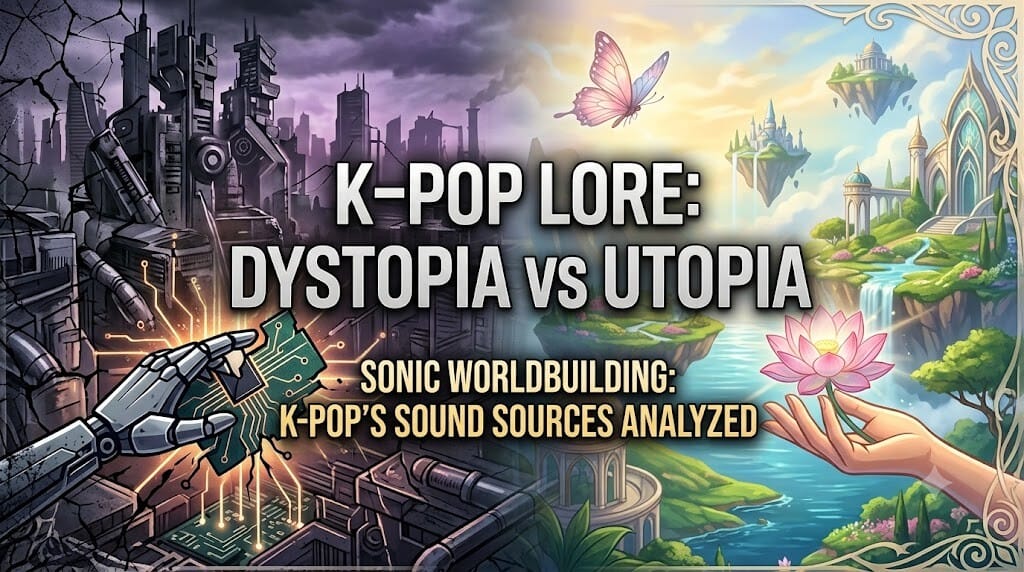
The global phenomenon of K-pop has long transcended simple musical arrangements, evolving into a highly complex medium where storytelling, visual identity, and lore intertwine. Central to this evolution is the concept of a “universe” or “worldview,” a narrative framework that binds a group’s discography together over multiple comebacks. Within these interconnected universes, structural dualities like “Dystopia” and “Utopia” serve as powerful thematic pillars, driving both the overarching storylines and the conceptual art direction of the artists.
While visual elements like cinematic music videos, intricate choreography, and stylized costuming offer an immediate gateway into these worldviews, the true immersion happens at the auditory level. Sound design in K-pop acts as a primary tool for musical visualization, translating abstract narrative landscapes into palpable emotional experiences. By dissecting the specific sonic textures, synthesizer layers, and structural choices employed by producers, we can uncover how the contrasting realms of despair and paradise are meticulously engineered through sound sources.
1. Engineering the Abyss: Sound Sources of K-Pop Dystopias
Dystopian narratives in K-pop often revolve around themes of rebellion, systematic oppression, internal conflict, and technological decay. To visualize a fractured, hostile world through audio, music producers deliberately steer away from clean, organic melodies, opting instead for abrasive, synthesized, and highly compressed sonic textures.
Aggressive Industrial Textures and Distorted Bass
The foundation of any dystopian K-pop track lies in its low-end frequency management. Producers heavily utilize distorted sub-basses, 808 glides with aggressive saturation, and industrial synth bass lines. These sound sources create an underlying sense of dread and physical tension.
For instance, groups like Stray Kids or ATEEZ frequently employ gritty, overdriven bass patches that mimic the rumbling of heavy machinery or post-apocalyptic environments. The distortion acts as a sonic metaphor for a broken society, injecting chaos and grit directly into the track’s core infrastructure.
Metallic Percussion and Found Sound Sampling
To emphasize a cold, mechanized, and authoritarian atmosphere, traditional drum kits are often replaced or layered with industrial, metallic percussion samples. Producers sample unconventional sound sources, such as:
- Anvil strikes and metallic clangs
- Mechanical gears turning or locking
- Screeching brakes or industrial alarms
- Heavy, synthesized footsteps
These sounds are heavily processed with digital delay and harsh reverbs, evoking the imagery of vast, hollow concrete structures or futuristic cybernetic cities. The rhythmic rigidity of these samples reinforces the theme of being trapped within an inescapable, oppressive system.
Minor-Key Harmonies and Dismal Vocal Processing
Melodically, dystopian tracks heavily favor minor scales—particularly the Phrygian or Aeolian modes—which naturally evoke feelings of unease, urgency, and sorrow. Vocals are rarely left dry or pristine; instead, they undergo intense digital manipulation. Megaphone filters, heavy vocoders, and claustrophobic pitch-shifting are applied to vocal tracks to simulate transmission static, artificial intelligence, or desperate cries filtered through gas masks. This vocal alienation underscores the loss of humanity often explored in dystopian lore.
2. Crafting Paradise: Sound Sources of K-Pop Utopias
In stark contrast, utopian concepts celebrate liberation, spiritual awakening, eternal youth, and emotional transcendence. When a K-pop storyline transitions into a utopia, the sonic palette undergoes a dramatic shift, moving from compressed, localized tension to wide, organic, and breathy frequencies that visualize boundless horizons and pristine landscapes.
Ethereal Pads and Spacious Reverb Trails
If a dystopia is defined by its suffocating lack of space, a utopia is defined by its infinite expanse. The primary sound sources used to visualize paradise are lush, evolving synthesizer pads and ambient textures.
Producers use long attack times on synth patches so that chords slowly bloom rather than strike aggressively. These pads are washed in expansive algorithmic reverbs and stereo delays, creating a wide soundstage that simulates a celestial, weightless environment. This technique wraps the listener in a warm, comforting sonic blanket, visualizing a safe haven free from conflict.
Organic Instrumentation and Bright Major Chord Progressions
Utopian visualization relies heavily on acoustic and organic sound sources to convey life, nature, and purity. Key instruments frequently introduced include:
- Acoustic harps and delicate glockenspiels
- Warm, uncompressed grand pianos
- Bright, strummed acoustic guitars
- Sweeping orchestral string sections
Musically, these instruments navigate bright, uplifting major chord progressions, often utilizing major 7th or 9th chords to introduce a sense of jazz-tinged nostalgia and dreamy optimism. The organic timbre of these sound sources immediately connects the listener to themes of nature, rebirth, and divine serenity, contrasting sharply with the synthetic rigidity of dystopian tracks.
Airy Vocal Layering and Angelic Harmonies
In a utopian sonic landscape, vocals are treated with a sense of reverence. Producers favor breathy, falsetto delivery styles and implement dense, multi-layered choral arrangements. High-frequency boosts are applied to give the vocals an “airy” or “shimmering” quality, making them sound almost angelic or supernatural. Group chants in a utopian context are mixed to sound communal, celebratory, and triumphant, visualizing a unified society that has successfully found peace.
3. Case Studies in Sonic Worldbuilding
To truly appreciate how these sound sources function in tandem with K-pop lore, we can examine specific, definitive releases from prominent groups that have masterfully executed these concepts.
Dreamcatcher’s Dystopia Trilogy: The Chaos of the Cyber World
Dreamcatcher is renowned for their rock-infused K-pop sound, which perfectly lends itself to dystopian storytelling. In tracks like Scream and Boca, the production team LEEZ and Ollounder blend heavy, distorted electric guitar riffs with aggressive Moog bass synths. The inclusion of sharp, operatic vocal stabs mixed with chaotic electronic build-ups visualizes a digital witch hunt, capturing the modern, cyber-dystopian terror outlined in their narrative lore.
Loona’s Butterfly: The Ultimate Utopian Transience
Loona’s Butterfly stands as a masterclass in utopian sound design. Produced by MonoTree, the track utilizes a minimalist but incredibly wide sonic landscape. The song is driven by a pitched-up, fluttering vocal synth sample that mimics the flapping of butterfly wings, layered over expansive, airy pads and a soft, non-aggressive future bass rhythm. The absence of harsh frequencies and the emphasis on high-end clarity create a weightless, transcendent atmosphere that perfectly visualizes the liberating, world-uniting message of the “LOONAverse.”
4. The Narrative Transition: Sonic Bridges Between Worlds
The most fascinating aspect of K-pop worldbuilding occurs when a group transitions from one state to another within a single song or album cycle. This narrative shift requires careful sonic bridging to guide the listener through the emotional evolution of the universe.
Structural Swaps and Genre Fusion
Producers often use sudden dynamic drops or structural subversions to signify a shift in reality. A track might begin with a suffocating, industrial dystopian verse, only to burst into an open, melodic, and organic utopian chorus. This juxtaposition creates a powerful catharsis, musically visualizing the act of breaking through a barrier or escaping captivity.
Symbolic Audio Motifs
Certain sound sources serve as recurring motifs across a group’s discography to signal the state of their universe. A specific synthesizer patch, a recurring nature sample (like rain transforming into birds chirping), or a distinct vocal effect can act as an auditory Easter egg. When a familiar dystopian sound is slowly stripped of its distortion or layered with organic strings over subsequent albums, the music itself tells the story of healing, evolution, and world restoration.
5. Conclusion: Music as a Conceptual Architecture
Ultimately, the visualization of universes in K-pop proves that audio is not just an accompaniment to visual media, but a dynamic architecture capable of building entire worlds on its own. Through the strategic deployment of sound sources—whether it is the gritty, suffocating distortion of a dystopia or the airy, expansive serenity of a utopia—K-pop producers construct tangible emotional landscapes. As the boundaries of K-pop worldbuilding continue to expand, the sophisticated engineering of these sonic realms will remain the driving force that transforms casual listeners into deeply immersed citizens of these musical universes.