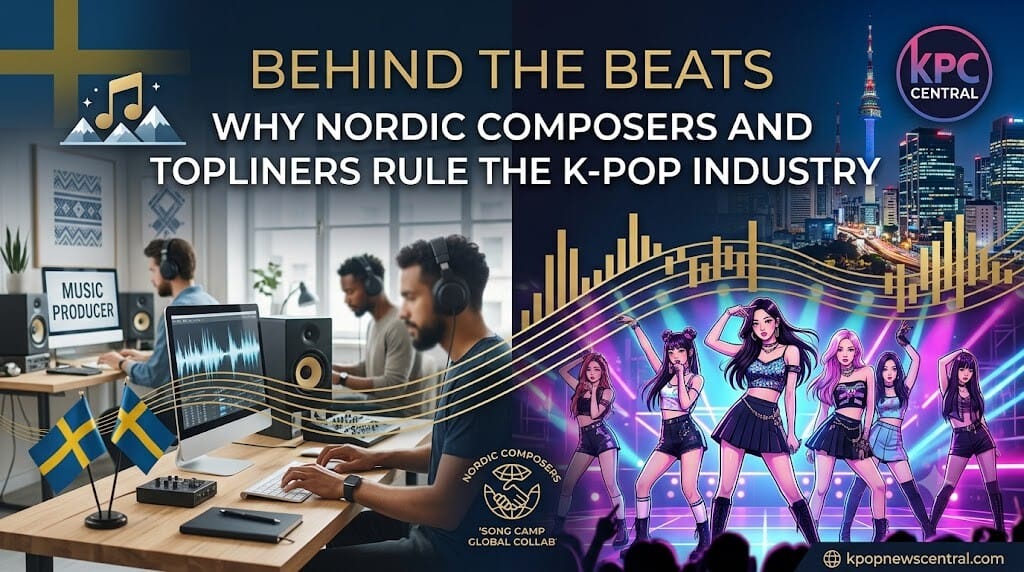
The global dominance of K-pop is no accident, but a close look at the album credits of top-tier idol groups like NMIXX, aespa, or LE SSERAFIM reveals an intriguing pattern. Alongside Korean producers, the names of foreign creators—particularly from Nordic countries like Sweden, Norway, and Denmark—consistently populate the tracklists of the industry’s biggest hits.
Why do South Korean entertainment powerhouses look halfway across the globe to collaborate with Scandinavian music creators? And how do these international artists craft the hyper-infectious melodies that define the genre? To unlock this secret, one must dive into the core architecture of K-pop production: the “Topliner” system and the phenomenon of the “Song Camp.”
H2: The Pillars of K-pop’s Division of Labor: The Topliner System
H3: Architects Crafting Melodies Over Beats
In traditional pop music, a single singer-songwriter often builds a track from scratch, composing both the instrumentals and the vocal lines. Modern K-pop production, however, relies on a highly specialized division of labor. Songs are built sequentially, splitting responsibilities cleanly between track makers (producers) and topliners.
A topliner is a melody architect who takes a pre-existing instrumental track—the beats, synth lines, and basslines provided by a producer—and layers the vocal melodies, guide lyrics, and “killing parts” over it. They design the narrative flow of the vocals that the audience will ultimately sing along to.
H3: Designing the 15-Second Architecture for Short-Form Challenges
Today’s K-pop is far more than an auditory experience; it is a visual performance art form optimized for global short-term consumption on platforms like TikTok and YouTube Shorts. Consequently, the reliance on a distinct, instantly addictive hook is greater than ever. Topliners dissect the song structure, tailored explicitly to highlight the unique vocal tones of individual idol members while engineering rhythmically explosive segments designed for viral choreography challenges.
H2: Why Nordic Composers Rule the K-pop Ecosystem
H3: A Musical Lineage from ABBA to Max Martin
Out of all the global musical hubs, why does Scandinavia hold such a dominant grip on the K-pop industry? Music critics trace this back to the region’s historical pop DNA.
Sweden, for instance, is a global pop superpower that birthed legendary icons like ABBA and modern hitmakers like Max Martin, the mastermind behind hits for Britney Spears, the Weeknd, and Taylor Swift. The hallmark of Nordic pop—intuitively memorable, structurally pristine, and deeply melodic hooks—aligns seamlessly with K-pop’s primary objective: undeniable public appeal.
H3: Bold Experimentalism Forged by the Eurovision Culture
The cultural impact of the Eurovision Song Contest cannot be understated. Growing up with this massive, theatrical spectacle, Nordic composers naturally internalized the art of dramatic song progressions, grandiose sonic scales, and daring genre mashups designed to captivate an audience within a strict three-minute window.
While switching abruptly from major to minor keys or intertwining hip-hop, R&B, and electronic pop within a single track might seem disjointed to minimalist Western pop producers, it is second nature to Nordic writers. This aligns perfectly with K-pop’s dynamic and unpredictable nature, a style championed by Swedish production duos like Moonshine and Sunshine, who have crafted defining sounds for groups like Red Velvet and aespa.
H2: Maximizing Sonic Synergy Through ‘Song Camps’
H3: The Global Melting Pots of Melody
The catalyst driving the collision between Nordic topliners and South Korean agencies is the Song Camp. A song camp is an intensive, collaborative residency hosted by major entertainment labels (such as SM, HYBE, or JYP) or publishing houses. They invite top-tier topliners, track makers, and lyricists from all over the world to a centralized studio location—either in Seoul or international creative hubs—to write music collectively for days at a time.
H3: An “Avengers-Style” Collaboration Breeding Originality
The operational environment of a song camp is incredibly fast-paced and dynamic. An entertainment agency provides a clear creative brief—for example, “We need a title track for Group X featuring aggressive sub-bass paired with a dreamy, ethereal vocal melody.” In response, a Swedish track producer, an American rapper, and a Korean topliner might find themselves in a room together, bouncing ideas off each other in real-time.
This clash of distinct cultural backgrounds results in hybrid, highly experimental sounds that defy standard genre categorization. Global creators often note that the intense pressure of K-pop deadlines forces out raw, instinctive creativity. While Korean labels once traveled abroad to source demos, the prestige of K-pop has shifted the dynamic entirely—global A-list writers now view a K-pop song camp invitation as a coveted career milestone.
H2: Conclusion: The Global Network Securing K-pop’s Future
Ultimately, K-pop’s sonic palette remains remarkably fresh and globally palatable because it is engineered through cross-border synergy from its inception. By overlaying the razor-sharp concepts, choreography, and visual world-building of Korean labels onto the foundational melody-crafting instincts of Nordic topliners—all facilitated by the infrastructure of global song camps—K-pop has cultivated a highly sustainable creative ecosystem.
By evolving from a regional genre into a massive, open-source collaborative platform for international artists, K-pop ensures its longevity. The magic that starts as a raw melody in a quiet Scandinavian studio before transforming into a stadium-shaking anthem in Seoul will continue to redefine the global music charts for years to come.