
K-pop has transcended its origins as a South Korean cultural export to become a truly global music phenomenon. One of the most pivotal drivers behind this massive international expansion is the strategic inclusion of multinational members within idol groups. What began as a cautious experiment a decade ago has now evolved into an essential industry standard. Entertainment agencies no longer rely solely on domestic talent; they actively scout across the globe, aiming to build groups that visually and culturally represent a diverse, worldwide audience from the moment they debut.
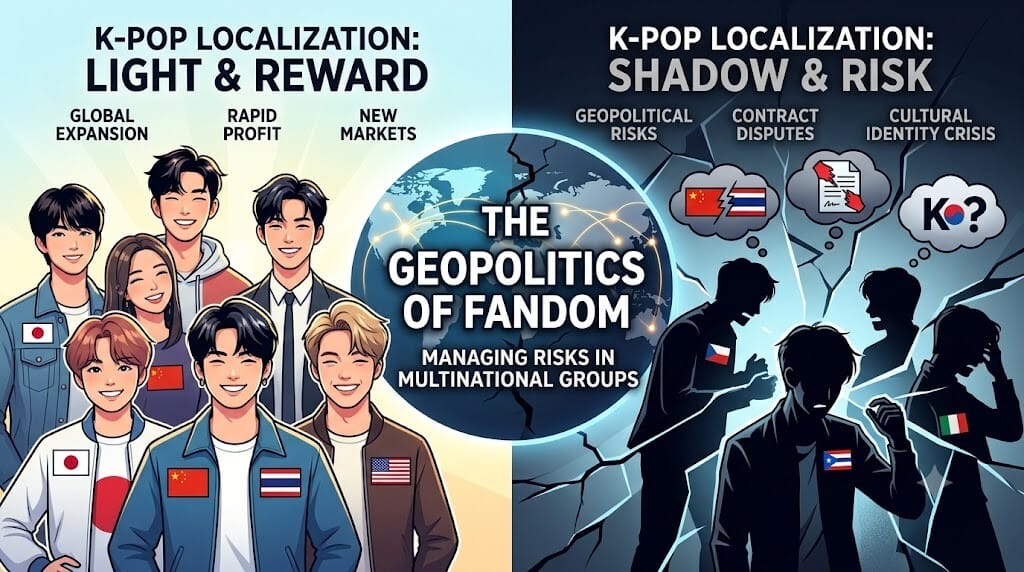
This approach, deeply rooted in the concept of ‘localization’ (현지화), is a highly calculated business strategy designed to conquer specific foreign markets. By debuting members from Japan, China, Southeast Asia, and the West, agencies can instantly bridge cultural gaps, overcome language barriers, and foster immediate emotional connections with local fans. However, this aggressive globalization strategy is a double-edged sword. While it has catapulted K-pop to unprecedented heights, it also brings complex geopolitical risks, contractual challenges, and an ongoing debate about the core identity of K-pop itself.
The Evolution of Multinational Groups in K-Pop
To understand the current landscape, it is crucial to look at how the inclusion of foreign members has evolved over the different generations of K-pop.
The Early Days: Testing the Waters
In the late 2000s, adding a foreign member was considered a bold, somewhat risky move. Agencies primarily targeted the massive Chinese and Japanese markets. Pioneers like Super Junior’s Hangeng or 2PM’s Nichkhun were introduced to act as cultural ambassadors. They were often the sole foreign representatives in their groups, tasked with opening doors for their domestic members in overseas markets.
The Golden Era of Global Castings
By the 3rd and 4th generations, multinational line-ups became the norm rather than the exception. Megagroups like TWICE, BLACKPINK, EXO, and NCT heavily relied on their Japanese, Chinese, Thai, and Western members to build massive, fiercely loyal international fandoms. These members were no longer just ‘guests’ in a Korean group; they were core pillars of the group’s musical identity and global marketing strategy.
True Localization: Exporting the K-Pop System
Today, the industry has shifted from merely importing foreign talent to exporting the entire K-pop training system. Agencies are now creating localized groups—such as NiziU in Japan, WayV in China, or KATSEYE and VCHA in the West—that consist entirely of non-Korean members singing in local languages. The strategy has shifted from “K-pop made in Korea” to “Global pop made with the K-pop methodology.”
The Bright Side: The “Light” of Localization
The financial and cultural benefits of this multinational strategy are undeniable, offering entertainment companies a fast track to global dominance.
Breaking Cultural and Language Barriers
The most immediate benefit of a multinational group is the elimination of the language barrier. When a group promotes in Japan, having a Japanese member speak naturally and understand cultural nuances on variety shows instantly endears the group to the local public. It transforms the group from a “foreign act” into something familiar and relatable, drastically reducing the friction of entering a new market.
Rapid Market Penetration and Profitability
Foreign members often bring a guaranteed, built-in audience from their home countries. Fans feel a strong sense of national pride seeing one of their own succeed on the global K-pop stage. This translates into massive physical album sales, lucrative local endorsement deals, and sold-out stadium tours in those specific regions, driving immediate and immense profitability for the agencies.
The Dark Side: The “Shadow” of Localization
Despite the massive financial upsides, relying heavily on foreign talent introduces a unique set of vulnerabilities that agencies struggle to control.
Geopolitical Risks and Cultural Clashes
K-pop artists are not immune to international politics. When historical or political tensions flare up between South Korea, China, or Japan, multinational groups often find themselves caught in the crossfire. Foreign members may face immense pressure from their home countries to make political statements on social media, which inevitably sparks intense backlash from the Korean public. A single geopolitical dispute can halt a group’s activities overnight and permanently damage their reputation.
The “Runaway” Controversy and Contract Disputes
A persistent shadow over the multinational strategy is the history of contract disputes. There have been several high-profile cases, particularly with Chinese members in the past, where artists utilized the rigorous K-pop training system to gain fame, only to abruptly terminate their contracts and return home to pursue highly lucrative solo careers. This has led to skepticism among some domestic fans regarding the loyalty and longevity of foreign members.
Dilution of the “K” in K-Pop
As agencies push for ultimate localization with completely non-Korean groups singing entirely in English or Japanese, an existential question arises: What makes K-pop, K-pop? If the music removes the Korean language and Korean members, critics argue it risks losing the unique cultural identity that made the genre special in the first place, potentially turning it into a generic, factory-produced global pop model.
Conclusion
The inclusion of multinational members is undeniably the most powerful engine driving K-pop’s current global expansion. The localization strategy is a high-risk, high-reward endeavor. While it brilliantly dismantles language barriers and opens up lucrative international markets, it simultaneously exposes agencies to uncontrollable geopolitical minefields and cultural identity crises. As the industry continues to evolve, finding the delicate balance between aggressive global expansion and maintaining the core essence of Korean pop culture will be the ultimate test for entertainment agencies.