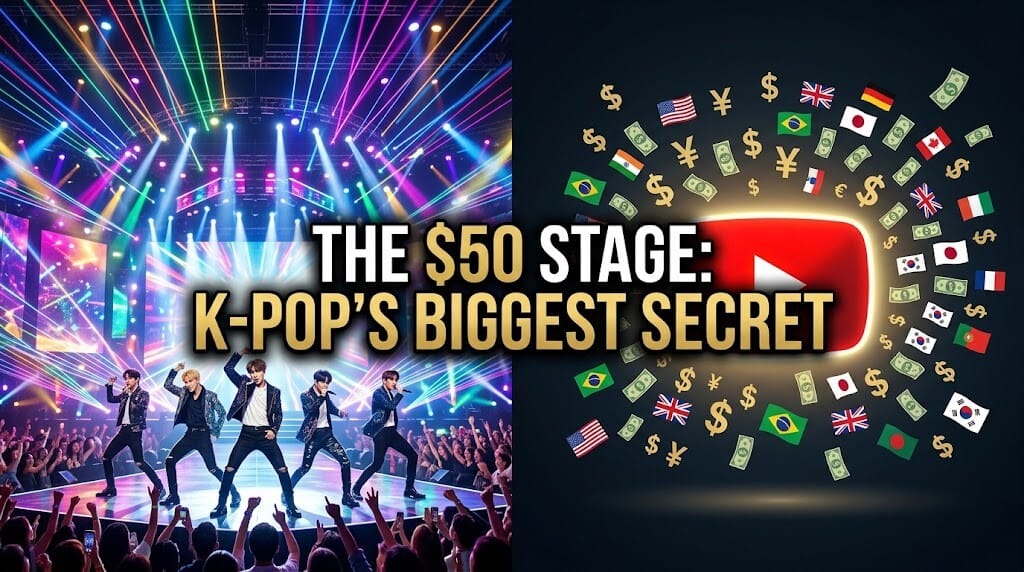
The South Korean television landscape presents one of the most fascinating economic paradoxes in the modern entertainment industry. Every week, major broadcast networks air highly produced music programs like KBS Music Bank, SBS Inkigayo, and Mnet M Countdown, featuring a lineup of the biggest names in K-Pop alongside desperate rookies fighting for a spotlight. Yet, if you look at the domestic Nielsen television ratings for these shows, the numbers are shockingly dismal. It is incredibly common for these flagship music programs to record viewership ratings of around 0.5% to 1.5%. By traditional broadcasting metrics, these shows are absolute failures, commanding almost zero terrestrial attention. To add insult to injury, the appearance fee networks pay to the artists is notoriously low, often hovering between $30 and $70 per group, regardless of whether they are an unknown rookie or a global Billboard-topping act.
Despite this blatant lack of domestic television viewership and the insultingly low compensation, K-Pop agencies fiercely compete for a time slot on these shows. They willingly plunge themselves into a financial deficit week after week during promotional periods. Agencies routinely spend tens of thousands of dollars on custom stage sets, backup dancers, high-end designer outfits, and professional styling teams just for a single three-minute performance that pays them the equivalent of a cheap dinner. On paper, it looks like a disastrous business model that should bankrupt a company. However, beneath the surface of these abysmal television ratings lies a highly sophisticated digital marketing strategy and a complex web of industry politics that makes these music shows the most crucial battleground in the K-Pop industry.
The Financial Black Hole of the Three-Minute Stage
To understand why agencies participate in this seemingly irrational financial behavior, it is necessary to examine the actual costs involved in putting a K-Pop idol group on a music show. The economics of a single broadcast appearance are heavily skewed against the entertainment companies.
The Measly Appearance Fees Explained
The broadcasting networks operate on an antiquated payment structure that was established decades ago when television was the undisputed king of media and appearing on TV was considered a privilege that artists should be grateful for. Even today, a standard music show appearance fee rarely exceeds 100,000 KRW (approximately $75). This fee is not per member; it is for the entire group. When divided among a heavily populated idol group, their managers, and their staff, the compensation is mathematically negligible. In an era where top-tier idols can command millions of dollars for brand endorsements or private concerts, the decision to spend an entire day at a broadcasting station for $50 seems absurd.
The Staggering Costs of Stage Production
While the networks pay a pittance, they demand perfection. The visual standard for K-Pop is astronomically high, and agencies bear the entirety of the production costs. A standard comeback stage for a major artist requires a custom-built physical set that matches the theme of the new album. These sets, which are built solely for a three-minute performance and destroyed afterward, can cost anywhere from $10,000 to $50,000.
Beyond the set architecture, the agency must pay for a small army of personnel. Hair and makeup professionals, wardrobe stylists who source luxury garments, and large crews of backup dancers all charge premium daily rates. Add the costs of transportation, meals for the entire staff during the grueling 15-hour recording days, and rehearsal space rentals, and a single week of music show promotions across four different networks can easily cost an agency upwards of $100,000. It is a massive financial hemorrhage that agencies budget for long before an album is even released.
Why Agencies Willingly Take the Loss
If the television ratings are near zero and the financial loss is staggering, the motivation for K-Pop agencies clearly lies outside the realm of traditional broadcasting. The true value of a music show appearance is found in digital asset generation and global reach.
High-Quality Video Assets for the Global Market
K-Pop is no longer a domestic industry; it is a global phenomenon. While nobody in South Korea is sitting in front of their television at 3:00 PM on a Friday to watch Music Bank, millions of fans across the United States, Latin America, Southeast Asia, and Europe are waiting for the performance clips to be uploaded to YouTube.
In this context, the broadcasting networks are essentially acting as highly subsidized, elite production studios for the agencies. For the cost of the stage set and styling, the agency gets access to multi-million-dollar broadcasting equipment, complex lighting rigs, professional camera operators, and elite audio mixing that they could never afford to replicate in-house on a weekly basis. The networks produce pristine, 4K resolution performance videos that serve as premium promotional material. The global YouTube views generate ad revenue, attract international brand sponsorships, and sell concert tickets overseas. The TV broadcast is merely the raw material; the digital afterlife of the performance is where the actual profit is made.
The Power of Fancams and Short-Form Content
The digital strategy extends far beyond the main broadcast clip. Music shows have adapted to the internet age by pioneering the “fancam” (Jikcam) culture. Networks now upload individual, fixed-camera performances for every single member of an idol group, as well as full-group choreography versions and behind-the-scenes shorts.
This hyper-fragmented content strategy is a goldmine for agencies. A single viral fancam can alter the entire trajectory of a group’s career. When a specific member’s facial expressions or dance moves go viral on YouTube, TikTok, or Instagram Reels, it brings massive, organic exposure to the group. These short-form digital assets fuel fan engagement, keep the idols relevant in the fast-paced social media algorithm, and provide endless content for fans to edit and share. The agency pays for the stage once, but the digital footprint pays dividends for years.
The Hidden Politics and Industry Leverage
Beyond digital marketing, the K-Pop industry is deeply entrenched in relationship management. The major broadcasting networks (KBS, SBS, MBC) and cable giants (CJ ENM) hold immense power over the wider entertainment ecosystem, creating a dynamic where compliance is mandatory for long-term success.
Maintaining Broadcast Network Relationships
Broadcasting stations control much more than just weekly music shows; they control highly rated weekend variety shows, lucrative reality programs, and the massive, heavily viewed year-end award ceremonies (Gayo Daejeon, Gayo Daechukje). Entertainment agencies view music show attendance as a necessary political tax to maintain favorable relationships with these powerful network executives.
If an agency boycotts a network’s music show because of the low pay and abysmal ratings, the network will retaliate by blacklisting that agency’s artists from their popular variety programs. For a rookie group, being banned from mainstream variety shows is a death sentence for their domestic public recognition. Therefore, agencies absorb the financial loss of the music show as a strategic “package deal” to ensure their artists get screen time on the programs that actually matter to the general public.
The Prestige of the Music Show Trophy
Despite the shift to digital consumption, winning first place on a public broadcast music show remains a critical milestone in a K-Pop group’s career. The music show trophy is a tangible metric of success, calculated through a mix of digital streaming scores, physical album sales, global fan voting, and broadcast points.
Securing a music show win instantly elevates a group’s status from “nugu” (unknown) to a recognized, bankable act. This status upgrade has direct financial implications. Once a group becomes a “first-place artist,” their appearance fee for university festivals, corporate events, and regional concerts skyrockets. The money an agency loses building extravagant sets for Inkigayo is quickly recouped when the newly crowned winning group hits the lucrative autumn university festival circuit.
Fandom Mobilization and Loyalty Building
Finally, music shows serve as a crucial physical touchpoint for hardcore fandoms. K-Pop relies on a parasocial business model where extreme fan loyalty translates into massive physical album sales and merchandise revenue.
Pre-Recordings as a Fan Experience
Because live broadcasts are unpredictable, networks rely heavily on pre-recordings (사전녹화) done in the early hours of the morning. Agencies invite hundreds of hardcore fans to fill the studio audience. For the fans, gaining entry to a pre-recording is highly competitive, often requiring proof of album purchases and official fan club membership.
Once inside, fans get to see their idols up close, interact with them between takes, and participate in coordinated fan chants that are broadcast to the world. This experience solidifies an intensely loyal core fanbase. The fans feel like they are directly contributing to the artist’s success by providing the energetic atmosphere needed for the broadcast. This emotional investment ensures that these fans will continue to buy multiple versions of the next album, stream the music 24/7, and purchase expensive concert tickets, fueling the ultimate economic engine of the agency.
Writer’s Opinion
Honestly, when you sit down and look at the raw numbers, it just seems completely insane, right? Like, you have these massive corporate agencies burning through fifty grand a week just to get a $50 paycheck from a TV station that literally nobody in Korea is even watching live. I mean… is it just me, or does it feel like a giant, glamorous scam sometimes? But then you look at how a single 4K YouTube fancam from that exact same stage pulls in 10 million views from fans in Brazil and France, and suddenly the math starts making weird sense. It’s kind of brilliant in a twisted way. The TV show isn’t the product at all; it’s just a heavily subsidized factory for making TikTok clips and YouTube shorts. You really have to admire the ruthless efficiency of the K-Pop machine, turning a total domestic broadcast failure into a global digital goldmine. It’s totally paradoxical, but hey, it clearly works!