The landscape of K-pop choreography has undergone a seismic shift over the past few years. Once defined by breathtakingly complex synchronization, intricate formations, and high-energy routines that required years of rigorous training to perfect, modern K-pop dancing looks remarkably different. Today, if you open any social media platform, you are bound to encounter idols and fans alike participating in short-form video challenges. This phenomenon has turned choreography into a vital marketing tool, but it has also triggered a fierce debate within the music industry and fandoms alike.
As TikTok and Instagram Reels became the primary drivers of viral music hits, entertainment agencies adapted their production strategies to fit these vertical, short-form formats. The pressure to create a viral “challenge loop” has fundamentally altered how choreographers approach their craft. While this shift has democratized dance and brought unprecedented global engagement to K-pop, it raises a critical question: Has the obsession with algorithmic virality compromised the artistic integrity and technical brilliance that once set K-pop apart?
The Rise of the 15-Second Hook: Designing for the Screen
The Anatomy of a TikTok Challenge
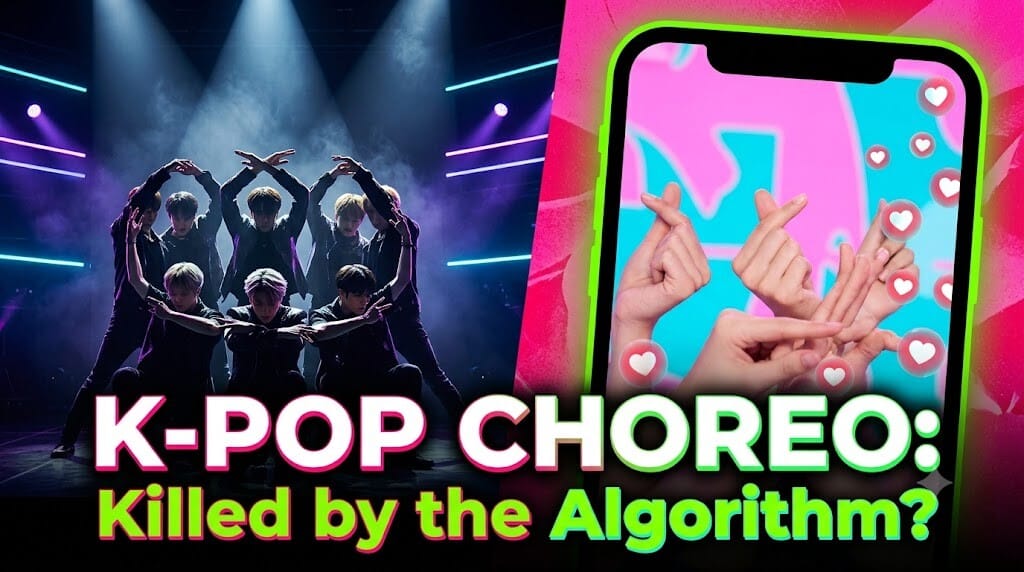
To understand how TikTok has influenced K-pop choreography, one must look at the structural changes in modern routines. In the past, a song’s choreography was treated as a cohesive, three-minute narrative arc. Today, dances are often built around a highly specific, 15-to-30-second window—usually the chorus or the post-chorus drop. This segment is meticulously engineered to be “point choreography” on steroids: simple, repetitive, visually striking, and easily framed within a vertical 9:16 smartphone screen.
Why Repetition Over-Indexed Technical Skill
When the primary goal of a dance routine shifts from stage performance to user replication, technical difficulty naturally takes a backseat. Choreographers are increasingly instructed by labels to simplify movements so that the average listener, regardless of their dancing ability, can mimic the steps at home. Consequently, intricate footwork and dynamic level changes have frequently been replaced by upper-body-heavy movements, exaggerated facial expressions, and hand-centric gestures. While effective for a smartphone screen, this repetition can make full-stage performances feel static and uninspiring.
The Dilemma: ‘Music to Watch’ vs. ‘Choreography to Copy’
The Loss of Complex Stage Formations
One of the most mesmerizing elements of classic K-pop was the formation changes. Groups utilized the entire depth and width of a theatrical stage, creating geometric patterns, illusions, and seamless transitions that looked spectacular from a wide camera angle. However, TikTok challenges require performers to remain relatively stationary and centered. As a result, modern choreography heavily favors linear, front-facing setups. The grand, theatrical storytelling of the stage is being sacrificed for a format optimized for a single, stationary smartphone lens.
The Standardization of Aesthetic Styles
As agencies chase the next viral trend, a sense of homogenization has crept into the industry. If a particular hand gesture or hip sway goes viral for one group, variations of that exact movement suddenly appear in dozens of subsequent releases. The unique sonic and visual identities of different groups are occasionally blurred under the pressure to fit the current algorithmic aesthetic. Instead of pushing creative boundaries, choreography risks becoming a formulaic checklist of viral-ready components.
The Counter-Argument: Democratization and Global Scale
Lowering the Barrier to Entry for Global Fans
Despite the criticisms, it is undeniable that TikTok challenges have bridged the gap between idols and fans in ways never previously imagined. Historically, K-pop was a spectator sport where fans admired the unreachable talent of their idols from afar. Challenges have transformed fans from passive consumers into active participants. When a fan learns a 15-second routine and posts it online, they feel a direct, kinetic connection to the artist, fostering immense loyalty and community engagement.
An Unrivaled Marketing Engine for Lesser-Known Artists
For groups from smaller entertainment agencies without multi-million-dollar marketing budgets, a viral TikTok challenge is a equalizer. A clever, catchy piece of point choreography can propel an obscure b-side track to the top of the global streaming charts overnight. In an industry where visibility is everything, the algorithmic boost provided by a viral dance challenge is a financial lifeline that agencies simply cannot afford to ignore.
The Future: Striking a Balance in the Post-TikTok Era
Hybrid Choreography Strategies
Recognizing the growing fatigue among purists, some forward-thinking choreographers and agencies are beginning to pivot toward a hybrid model. Instead of dumbing down an entire routine, they create highly complex, performance-driven choreography for the music video and music shows, while carving out a separate, heavily modified, simplified version strictly for social media promotional clips.
The Resilience of Performance Art
Ultimately, K-pop has always been an industry defined by its ability to adapt and reinvent itself. While the initial gold rush of the TikTok era led to over-simplification, the market correction is already underway. Fans are proving that while they enjoy participating in easy challenges, they still pay premium concert ticket prices to see awe-inspiring, high-caliber athletic performances that they cannot replicate at home.
Writer’s Opinion
I believe TikTok hasn’t inherently ruined K-pop choreography, but it has certainly forced it into a temporary creative chokehold. It’s hard to blame agencies for chasing virality when a single 15-second clip can determine a song’s commercial survival. However, the magic of K-pop has always lived in its larger-than-life, untouchable stage presence. When dances become too easy just so everyone can copy them, the awe-factor evaporates. The future of K-pop dance relies entirely on balance—treating social media challenges as a fun marketing byproduct rather than letting the algorithm dictate the boundaries of the art itself.