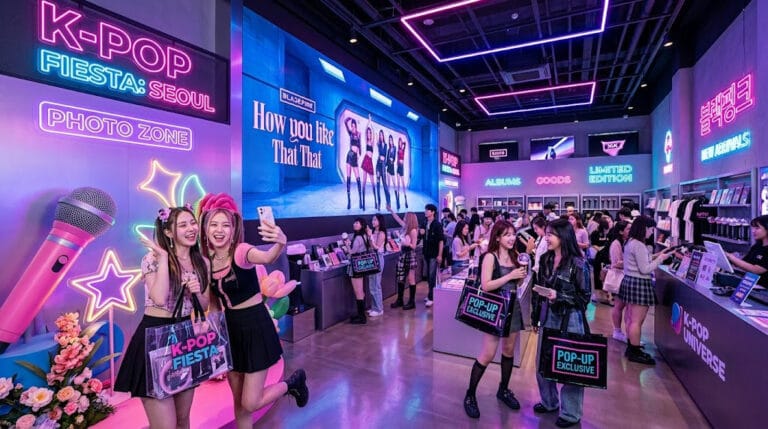
Every year as winter approaches, the global music industry turns its eyes toward South Korea. The year-end K-pop award ceremonies—such as the Mnet Asian Music Awards (MAMA), Melon Music Awards (MMA), and Golden Disc Awards—have evolved from standard trophy presentations into massive, multi-million dollar cultural spectacles. These events are no longer just about recognizing musical achievements; they serve as an annual battleground where entertainment powerhouses push the absolute boundaries of live performance production.
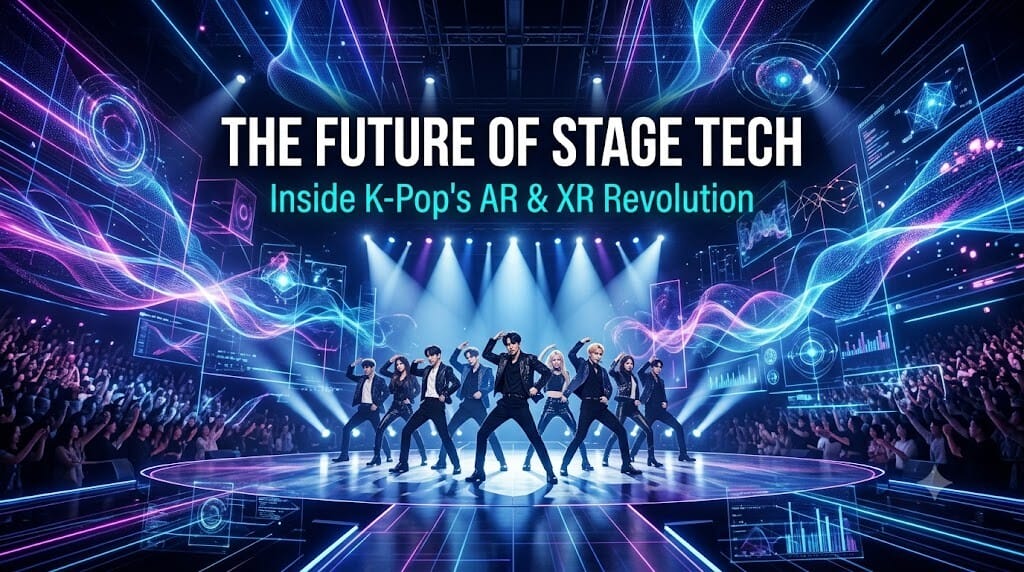
What truly sets modern K-pop stages apart on the global scene is the breathtaking integration of cutting-edge technology. The physical limitations of traditional concert arenas have been completely shattered. Through a seamless blend of live performance, real-time spatial computing, and hyper-realistic digital environments, these year-end shows are actively rewriting the rules of broadcast television and immersive media, turning every single performance into an futuristic artistic statement.
The Paradigm Shift: Moving Beyond Physical Lighting and LED Screens
For decades, concert staging relied heavily on physical components: moving trusses, pyrotechnics, and massive LED background screens. While these elements created immense scale, they remained fundamentally two-dimensional for the viewing audience at home. The background was always distinct from the performer, creating a clear visual disconnect.
K-pop award shows revolutionized this space by treating the broadcast camera not just as a passive recording device, but as an active lens that interacts with a three-dimensional digital universe. Instead of simply projecting a pre-rendered video on a screen behind an idol group, modern productions use real-time rendering engines—like Unreal Engine and Notch VFX—coupled with advanced mechanical tracking sensors attached directly to the broadcast cameras. This ensures that as the camera cranes, pans, or zooms, the digital background shifts perspective in perfect, seamless synchronization, effectively turning the entire arena into a boundless living environment.
The Virtual Expansion: How AR and XR Reframe the Idol Performance
To understand how these performances achieve their mind-bending depth, it is crucial to distinguish between the two primary technologies driving the revolution: Augmented Reality (AR) and Extended Reality (XR). While both blend physical and digital elements, they serve entirely different artistic functions on the K-pop stage.
Augmented Reality (AR) and Spatial Spectacle
Augmented Reality introduces three-dimensional digital objects directly into the live, physical space of the arena. When watching through the broadcast stream, viewers see massive dragons soaring over the audience, futuristic buildings rising out of the mosh pit, or intricate cosmic star systems swirling around a group as they dance.
The magic of modern K-pop AR lies in its lighting and shadow interaction. Using advanced real-time physics simulators, the digital objects reflect the actual, physical stage lights flashing in the arena. If a physical red strobe light flashes on stage, the wings of an AR creature flying above will catch that exact shade of red in real time. This micro-level attention to detail completely tricks the human eye, making the impossible look deeply rooted in physical reality.
Extended Reality (XR) and Virtual Set Extensions
Extended Reality takes the concept a massive step further by completely replacing or infinitely extending the physical world. In a typical XR setup, a group performs on an enclosed stage wrapped in high-density LED floors and walls. Through the camera lens, however, those physical LED walls disappear.
Using virtual set extensions, the edges of the physical stage blend seamlessly into a vast, digital wasteland, a sprawling futuristic cyberpunk city, or a hyper-dimensional dreamscape. The performers are no longer just dancing in front of a screen; they are physically encapsulated inside a completely fictional universe. This technology allows groups like aespa, NCT, or Stray Kids to instantly transition across multiple completely different planetary environments within a single four-minute song tracking shot, achieving a level of cinematic narrative continuity that was previously impossible in a live broadcast format.
Volumetric Captures and Real-Time Interactive Graphics
The technological ambition of K-pop year-end stages extends beyond environmental design and into the digital representation of the human body itself. One of the most groundbreaking advancements deployed in recent award cycles is the integration of Volumetric Display and real-time motion capture systems.
Prior to the live event, artists are recorded in specialized studios surrounded by hundreds of high-definition cameras that capture their physical forms, movements, and expressions from every single angle simultaneously. This data is converted into a highly detailed 3D digital avatar.
During the live broadcast, these volumetric assets are projected onto the stage alongside the real, living artists. Audiences watch in awe as giant, 50-foot digital clones of the performers mirror their exact choreography from above, or dance in perfect synchronization with their physical counterparts. Furthermore, live motion-tracking sensors allow real-time interactive graphics—such as trails of digital fire, shattering glass fragments, or glowing auroras—to emit directly from the idol’s limbs as they execute sharp choreographic drops, translating kinetic human energy directly into digital poetry.
Architectural Harmonization: Balancing Human Artistry with Technical Precision
The true triumph of K-pop’s stage evolution is that the technology never eclipses the human performance. In lesser productions, heavy reliance on digital graphics can make a show feel cold, artificial, or gimmicky. K-pop directors avoid this pitfall through meticulous architectural harmonization.
Every camera angle, lighting cue, and digital asset is storyboarded down to the exact millisecond alongside the group’s choreography. If a member makes a sharp striking motion with their hand at exactly 2 minutes and 14 seconds, the AR lightning bolt hitting the stage must land at that precise frame. This requires immense discipline and technical mastery from the idols themselves, who must perform complex, physically grueling routines while remaining acutely aware of invisible digital boundaries. The result is a breathtaking synthesis where human physical prowess and advanced computer engineering elevate one another to create a completely new medium of live entertainment.
Writer’s Opinion
The technological leap seen in year-end K-pop stages over the last few years is nothing short of revolutionary. It reminds us that K-pop has completely outgrown the labels of just “music” or “pop culture”—it is now a primary driver of global media innovation. What fascinates me most is how these directors use cold, complex technologies like AR, XR, and real-time rendering engines to evoke incredibly raw, warm emotional responses from millions of global fans sitting behind phone and TV screens. By turning a simple live performance into a boundless, cinematic experience, K-pop has set an entirely new global standard for live entertainment, proving that the future of music is a world where the only boundary is human imagination.