
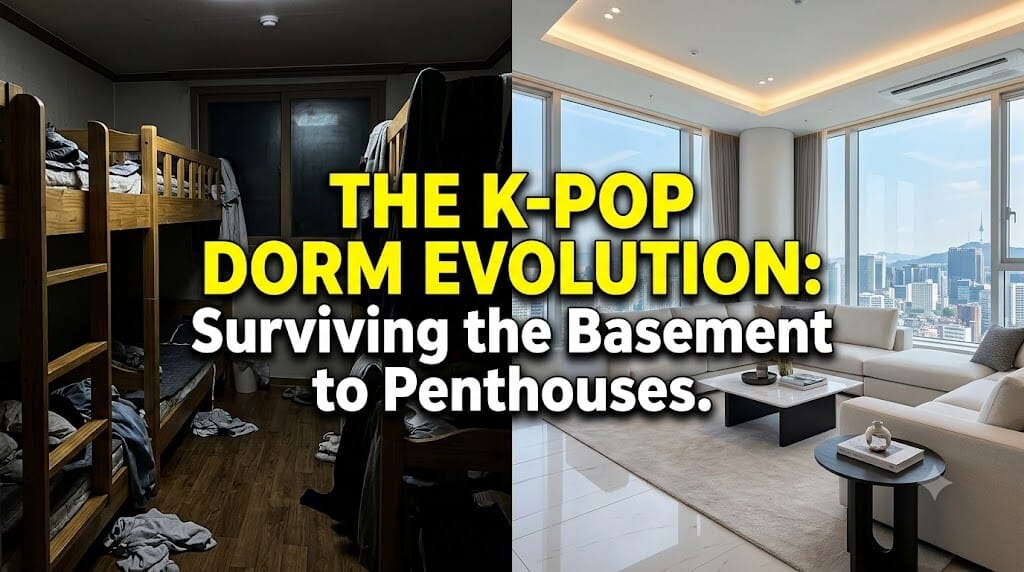
The glittering world of K-pop is often defined by perfectly synchronized choreography, flawless high-end fashion, and chart-topping music that dominates global trends. However, behind the heavily curated public appearances and polished music videos lies a deeply fascinating structural evolution that fans rarely get to see in its entirety: the transformation of the idol dormitory. For decades, the living arrangements of K-pop idols have been meticulously managed and closely monitored by entertainment companies, serving as both a practical logistical necessity and a surprisingly powerful psychological tool. In the industry’s infancy, idol dormitories were notorious for being incredibly cramped, poorly ventilated spaces where upwards of five to ten teenagers shared a single bathroom and slept on squeaky, stacked bunk beds. These intensely restrictive living conditions were not just a byproduct of low budgets or startup constraints; they were an intentional, high-pressure crucible designed to strip away individual egos and forge an unbreakable, cohesive sense of group identity from day one.
As the South Korean music industry expanded into a multi-billion-dollar global phenomenon, the culture and expectations surrounding these idol dormitories underwent a dramatic and necessary paradigm shift. The classic, highly romanticized narrative of “struggling together in a cramped basement” has gradually been replaced by stories of high-end luxury residences, sprawling high-rise penthouses, and, eventually, complete residential separation as group members gain seniority and wealth. This evolution from cramped, shared quarters to luxurious, highly individualized living spaces is not merely a reflection of a group’s financial success or the industry’s overall growth. It is a profound psychological journey that maps directly onto the career trajectory of an idol. The shift vividly highlights how the mental, emotional, and spatial needs of artists change drastically as they transition from desperate, wide-eyed rookies seeking a breakthrough to seasoned, independent veterans striving for career longevity and personal well-being. Understanding this specific housing evolution offers a remarkably unique lens through which we can analyze the delicate, often precarious balance between maintaining flawless group cohesion and fostering individual mental health in the high-pressure ecosystem of South Korean entertainment.
The Survival Era: Cramped Dormitories and Forced Bonding
The Harsh Reality of Trainee and Rookie Housing
If you examine the history of the first, second, and even early third generations of K-pop, the fundamental concept of the idol dorm was almost entirely synonymous with a rigorous survival camp. Entertainment companies frequently operated on razor-thin profit margins during their early years, and dedicating large, comfortable budgets to trainee or rookie housing was simply out of the question financially. Newly formed groups were routinely placed in small, basement-level apartments or outdated, aging villas tucked away in less glamorous neighborhoods of Seoul. It was entirely commonplace for an eight or nine-member group to share a single, cramped bedroom, sleeping on thin mattresses spread side-by-side across the living room floor or stacked vertically in triple bunk beds. Privacy was an absolute luxury that simply did not exist in their vocabulary. Live-in managers often resided with the idols in these tight quarters, strictly monitoring their restrictive diets, grueling practice schedules, and even their limited mobile phone usage. The dormitory, in this phase, was less of a comforting home and much more of an exhausting extension of the practice room.
Forging Unbreakable Teamwork Through Shared Struggles
From a purely psychological standpoint, these intensely cramped and chaotic quarters served a distinct, if somewhat harsh, purpose in the development of a group. When diverse individuals are forced into such incredibly close physical proximity under high-stress, high-stakes conditions, they typically face two outcomes: they either break apart entirely due to the friction, or they form an impenetrable, family-like bond. For the successful K-pop groups that survived this era, this forced cohabitation bred a unique, powerful type of siblinghood. By navigating frantic morning bathroom schedules, sharing late-night instant noodles in total secrecy, and emotionally comforting each other after devastatingly harsh monthly evaluations from their trainers, members developed an almost telepathic understanding of one another’s shifting moods, physical limits, and personal boundaries. This deep, unspoken, cellular-level synchronization is precisely what made their live stage performances so captivatingly tight and uniform. The shared, visceral struggle of surviving in a cramped dorm became a foundational, unifying narrative for the group’s teamwork, effectively instilling a collective hunger for success that superseded any individual ambition.
The Transition Period: Gaining Space and Personal Identity
Moving Up to Upgraded Shared Apartments
As successful groups enter their third or fourth year of active promotion and begin generating substantial revenue through physical album sales, extensive world tours, and lucrative brand endorsements, entertainment companies typically reward their hard work with a highly anticipated, significant housing upgrade. This pivotal transition period marks the very first major shift in the idol living paradigm. The group is finally moved out of the cramped, multi-member basement rooms and relocated into luxury apartment complexes situated in prime real estate areas of Seoul, such as the affluent districts of Gangnam, Cheongdam, or Hannam-dong. In these significantly upgraded dormitories, the square footage of the living space expands exponentially, but the most vital, life-changing alteration occurs on an individual level: members finally receive their own private bedrooms.
The Vital Need for Privacy and Mental Decompression
The profound psychological impact of finally possessing a private room with a door that closes cannot be overstated in this industry. In the highly scrutinized, relentless life of a prominent celebrity, where nearly every public move, facial expression, and spoken word is captured by flashing cameras and passionate fans, the mental and emotional toll is unimaginably immense. The upgraded, private dorm room provides the idol’s first real, undisturbed sanctuary. Psychologically speaking, having a guaranteed space to mentally decompress completely alone prevents the rapid, devastating burnout that plagues so many young entertainers in the industry. It allows members to slowly begin discovering and cultivating their own distinct personal tastes—whether that means meticulously decorating their rooms, engaging in quiet solo hobbies like gaming or producing music, or simply sitting in absolute, uninterrupted silence for hours. During this phase, teamwork naturally evolves from being a rigid product of physical necessity and forced proximity into a conscious, mature, and deliberate choice made by young adults who respect each other’s newly established boundaries.
The Veteran Stage: High-End Residences and Complete Separation
The Shift to Luxury Individual Apartments
When a prominent K-pop group successfully navigates the infamous “seven-year curse” (the standard, legal length of an initial idol contract in South Korea) and collectively decides to renew their contracts, the group’s living arrangements generally undergo their final and most drastic transformation. At this veteran stage, the traditional concept of the shared group dorm is completely and permanently abandoned. Instead, the modern industry standard for senior, highly successful idol groups firmly adopts the “separate but together” residential model. Members officially move out of the shared company penthouse and utilize their accumulated wealth to purchase or rent their own sprawling, individual luxury apartments. However, to maintain a lingering sense of unity, friendship, and crucial logistical ease for their shared security and management teams, members very frequently choose to live in the exact same ultra-luxury apartment complex, merely residing on different floors or in adjacent buildings. High-end, heavily fortified residential complexes like Hannam The Hill, Nine One Hannam, or Seoul Forest Trimage have become incredibly famous for simultaneously housing multiple independent members of the exact same veteran idol groups.
Redefining Group Dynamics and Securing Longevity
This ultimate residential separation represents a deeply fascinating evolution in the mechanics of K-pop teamwork. In the past, anxious fans would intensely worry that members moving out of a shared dorm signaled the inevitable, looming disbandment of their favorite group. Today, however, it is widely and accurately recognized by industry experts as the absolute healthiest, most effective way to sustain a musical group’s longevity over a decade. By the time they reach this elite veteran status, the members have already entirely mastered their stage synchronization; they absolutely do not need to live together to instinctively understand each other’s intricate dance cues or vocal harmonies. In fact, completely removing the mundane, daily friction of typical domestic disagreements—such as who forgot to wash their dishes, whose alarm is ringing too loudly, or whose pet is causing a mess—often drastically and immediately improves their interpersonal relationships.
How Separation Actually Saves K-Pop Groups
Mitigating Burnout and Preventing Conflict
The modern, evolved K-pop industry has finally realized that you simply cannot manage or treat a seasoned, wealthy artist in their late twenties or early thirties the exact same way you treat an anxious, dependent teenage rookie. Providing the option for separate luxury housing is not just an ostentatious financial flex for the company; it is a highly critical, calculated strategy for preserving career longevity and protecting mental health. It fundamentally acknowledges that true, long-lasting teamwork among fully grown adults requires ample physical space, fierce independence, and a deep, mutual respect for personal privacy. By eagerly allowing and encouraging members to live independently, entertainment companies actively prevent the toxic resentment, exhaustion, and claustrophobia that historically tore older, legendary groups apart in previous generations.
Cultivating Mature Teamwork in the Modern Era
When veteran members eventually meet up for intense comeback practice sessions, recording studio days, or chaotic promotional activities today, they do so with genuinely refreshed energy and real, palpable excitement to see one another, rather than out of exhausting daily obligation. The residential separation allows them to completely shed the heavy, constant burden of maintaining their cheerful “idol persona” while at home, allowing them to fully lean into their authentic, individual identities as regular adults. This newfound independence brings a much more diverse, grounded, and emotionally mature energy back to the group’s overall dynamic when they reunite. The fascinating evolution of the idol dorm is, therefore, a masterclass in applied human psychology—ultimately proving that while extreme closeness initially creates a team, strategic distance is very often what preserves it forever.
Writer’s Opinion
So, looking back at this whole wild housing journey… is it really just about the money and finally getting a fancier place to sleep? Honestly, when you think about it, it’s pretty crazy how much physical space dictates human relationships, right?! Back in the day, companies forced these poor kids to suffer together in a tiny, sweaty room because shared trauma kind of bonds you for life—which sounds super intense, but hey, it actually worked. But now? I think the realization that total separation actually saves a group from completely breaking up is absolutely brilliant. Isn’t it just wild how moving into totally separate luxury apartments might actually be the ultimate secret to a group staying together for 10 or 15 years? Like, maybe they just got totally sick and tired of fighting over who forgot to take out the trash! I guess at the end of the day, personal space isn’t just some flashy luxury in K-pop; it’s the absolute key to mental survival… Makes total sense when you really think about it, doesn’t it?