The global music landscape is currently dominated by two distinct powerhouses: the meticulously crafted world of K-pop and the historically dominant Western music industry. While both share the ultimate goal of producing chart-topping superstars and generating massive revenue, their approaches to discovering, nurturing, and launching talent are fundamentally opposed. Understanding how the K-pop training system differs from traditional artist development in the Western music industry requires a deep dive into the cultural, financial, and philosophical frameworks that shape these two entertainment behemoths.
In recent years, the explosive global success of groups like BTS, BLACKPINK, and NewJeans has turned the spotlight onto the Korean entertainment model. Western labels, historically reliant on organic discovery and independent artist growth, are now studying the highly structured, almost industrial approach of Seoul’s mega-agencies. However, the Western model, which champions individual authenticity, self-expression, and the “started from the bottom” narrative, continues to produce the world’s biggest solo artists. This article breaks down the anatomy of both systems, comparing the grueling trainee life of K-pop with the A&R-driven trajectory of Western pop, and explores the core differences that define modern pop stardom.
The Core Philosophies: Manufacturing vs. Organic Growth
To understand the practical differences in artist development, we first have to look at the underlying philosophies of both industries. They view the creation of a pop star through entirely different lenses.
The K-Pop In-House Trainee System
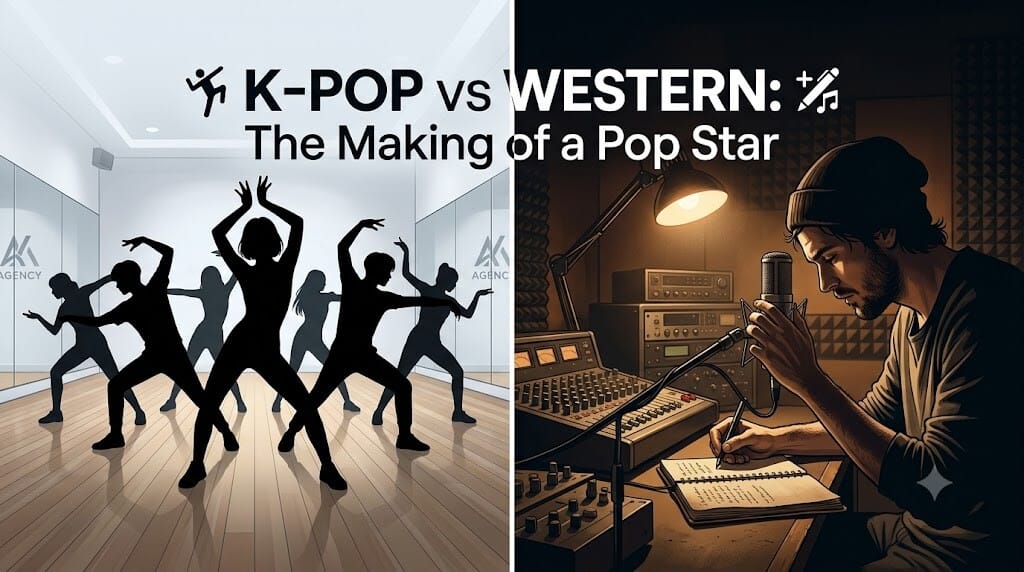
The K-pop industry operates on a model of vertical integration and intense curation. Entertainment companies like HYBE, SM, JYP, and YG act as all-encompassing academies. The core philosophy is that a star can be meticulously engineered from raw potential. Talent is just the baseline; discipline, adaptability, and flawless execution are the true requirements. Agencies invest years of time and millions of dollars into a trainee before they ever release a song. The goal is to create an idol who is not just a singer, but a multifaceted entertainer—a perfect package of visuals, personality, and performance.
The Western Independent Hustle
Conversely, the traditional Western music industry favors “organic” growth. Record labels typically look for artists who have already done the heavy lifting: developing a unique sound, writing their own songs, building a local fanbase, or going viral on platforms like TikTok or SoundCloud. The philosophy here is that authenticity cannot be manufactured in a boardroom. An artist’s value is intrinsically tied to their personal narrative and creative autonomy. Labels step in later in the process to provide capital, distribution, and global marketing, rather than building the artist from scratch.
Auditions and Scouting: Finding the Raw Material
How an aspiring singer actually gets their foot in the door is the first major point of divergence between the East and the West.
Global Casting in K-Pop
K-pop agencies hold massive, highly organized global auditions. Scouts travel to cities worldwide—from Los Angeles to Sydney to Tokyo—looking for specific traits. They aren’t necessarily looking for a finished product. They are looking for visual appeal, a sense of rhythm, and coachability. A 12-year-old with striking features and basic coordination might be selected over an 18-year-old vocal powerhouse if the younger candidate fits the company’s long-term vision for a future group. It is highly competitive, and passing an audition merely earns you the title of “trainee,” not a guarantee of debut.
Viral Sensations and A&R in the West
In the West, Artists and Repertoire (A&R) representatives are the talent scouts. Historically, they scoured sticky-floored clubs and local showcases. Today, they scour data. Western scouts look for spikes in streaming numbers, TikTok virality, and independent hustle. An artist like Justin Bieber was found on YouTube; Billie Eilish gained traction on SoundCloud. The Western label wants proof of concept before they write a check. They want an artist who already knows who they are and has a sound that is actively resonating with an audience.
The Curriculum: What Does It Take to Debut?
The day-to-day life of an artist in development couldn’t be more different depending on which hemisphere they are signed in.
K-Pop: The 360-Degree Idol Education
Once a trainee enters a K-pop agency, they are subject to a grueling, heavily structured curriculum. This is essentially a boarding school for pop stars.
- Vocal and Dance Training: Trainees undergo rigorous daily classes, often practicing choreography until the early hours of the morning to achieve perfect synchronization.
- Media and Language Training: Because K-pop targets a global audience, trainees take language classes (English, Japanese, Mandarin) and undergo intense media training to learn how to handle interviews, avoid scandals, and maintain a pristine public image.
- Monthly Evaluations: The pressure is immense. Trainees face monthly evaluations where they perform for company executives. Those who fail to show adequate improvement are cut from the program. This process can last anywhere from six months to ten years before an idol finally debuts.
Western Pop: Focus on Musical Identity
Western artist development is far less structured. There are no mandatory dance classes or dormitories.
- Studio Time and Co-Writing: Development usually means pairing the artist with established producers and songwriters to refine their sound. The focus is on finding the right “hit” rather than perfecting a synchronized dance routine.
- Brand Building: While media training exists, it is usually much lighter. Western artists are encouraged to be outspoken, controversial, or edgy if it fits their brand. Authenticity (even if it’s messy) is prized over polished perfection.
- Live Experience: Development often happens on the road. A new artist might be sent as an opening act on a grueling tour to learn stage presence the hard way—by performing in front of unenthusiastic crowds.
Financial Investment and Contracts
The financial structures of these two systems dictate how artists are treated and how profits are shared once success is achieved.
The Cost of a K-Pop Trainee
K-pop agencies take on massive financial risk. They house, feed, and train dozens of hopefuls for years, knowing only a fraction will ever debut. It is estimated that debuting a single idol group can cost an agency upwards of $2 to $3 million. Historically, this led to controversial “break-even” contracts, where idols did not get paid until they paid back their training debt (though major agencies have largely reformed this practice). Because the agency builds the idol from the ground up, the agency retains tight control over the intellectual property, group name, and artistic direction.
Western Record Deals and Advances
In the West, an artist usually signs a record deal and receives a cash advance. This advance must be recouped by the label before the artist sees standard royalty checks. The label pays for marketing, music videos, and distribution, but the artist is largely responsible for their own day-to-day living expenses and personal development out of that advance. Because the artist brings their own talent and often their own songs to the table, they have significantly more leverage to demand creative control and higher royalty rates.
Debut Strategy and Fan Engagement
The culmination of artist development is the debut, and how the artist interacts with the public is fundamentally different.
Manufactured Perfection and Parasocial Relationships
A K-pop debut is a massive, highly orchestrated event. The group is unveiled with a high-budget music video, a cohesive visual concept, and a pre-planned promotional tour on Korean music shows. The system is designed to foster intense parasocial relationships. Idols are expected to engage with fans daily on platforms like Weverse or Bubble, maintaining a boyfriend/girlfriend or best friend persona. The fandom is highly organized, mobilized to stream, buy physical albums in bulk, and defend the group online.
Relatability and Organic Community Building
A Western debut is often a slower burn. An artist might release a string of singles before dropping an EP or an album. While major pop stars do have massive, mobilized fanbases (like Taylor Swift’s Swifties or Beyoncé’s BeyHive), the expectation of daily, intimate access is lower. Western artists often maintain a slight distance, cultivating an aura of coolness or artistic untouchability, rather than the heavily curated “accessibility” of a K-pop idol.
The Convergence: Are The Systems Merging?
Interestingly, as the global music market shrinks into a single digital village, we are seeing a fascinating cross-pollination between the two systems. Western labels, envious of the dedicated K-pop fandoms and massive physical album sales, are attempting to create their own localized groups using K-pop methodologies (like the joint ventures that created KATSEYE or VCHA). They are recognizing that raw talent isn’t always enough without intense, strategic packaging.
Simultaneously, K-pop is adopting Western ideals. Modern K-pop fans increasingly demand that their idols have a hand in songwriting and production, pushing back against the “manufactured” label. Groups like Stray Kids or SEVENTEEN are heavily involved in their own creative process, blurring the lines between the engineered idol and the authentic artist.
Writer’s Opinion
So, the fundamental difference really boils down to extreme control versus organic chaos It is completely fascinating how Western labels are now desperately trying to mimic the K-pop boot camp style through global auditions, while Korean idols are simultaneously fighting for the very creative freedom that Western artists take for granted. I sometimes wonder if we are moving towards a bizarre middle ground where every pop star is a highly trained, yet supposedly ‘indie-spirited’ hybrid. The sheer level of money, sweat, and psychological engineering that goes into making a simple three-minute pop song in the K-pop industry is staggering. Are we just consuming perfectly engineered products instead of raw human emotion? Either way, the music industry is evolving faster than ever, and the traditional A&R playbook is officially out of date.