
The global phenomenon of K-Pop has undeniably reshaped the global music industry, transforming from a niche regional genre into a multi-billion-dollar cultural juggernaut. With acts like BTS, BLACKPINK, SEVENTEEN, and Stray Kids selling out massive stadiums worldwide, one would naturally assume that South Korea, the undisputed birthplace of this movement, boasts a plethora of state-of-the-art concert venues. However, the reality behind the glitz and glamour of these flawless performances has historically been one of severe infrastructural bottlenecks. For decades, South Korea’s domestic live music scene has been handcuffed by a glaring lack of dedicated, large-scale arenas designed specifically for popular music. Instead, entertainment agencies and artists have been forced into a brutal, never-ending competition to secure dates at aging sports facilities, university gymnasiums, and multi-purpose stadiums that were never acoustically engineered for high-fidelity music performances.
But the landscape is finally shifting, marking the dawn of a new era in South Korea’s entertainment infrastructure. We are currently witnessing a massive influx of capital, intense political lobbying, and fierce competition among local governments to build the nation’s very first generation of dedicated K-Pop arenas. This is no longer just about music; it is a high-stakes war involving multi-national conglomerates, real estate developers, and city planners all vying to capture the lucrative economic ripple effects of K-Pop tourism. From the newly opened Inspire Arena in Yeongjongdo to the highly anticipated Seoul Arena in Chang-dong, the race to build the ultimate K-Pop mecca is fundamentally rewriting the geographical and economic map of the Korean entertainment industry.
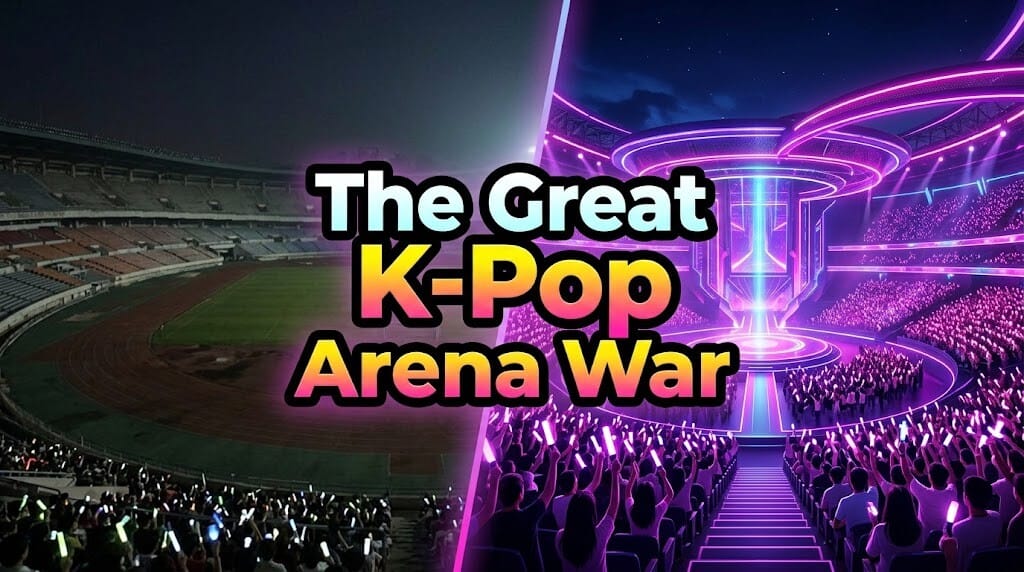
The Historic Struggle: Escaping the Brutal KSPO Dome Rental War
For anyone familiar with the Korean music industry, the struggle to find adequate concert venues is a well-documented crisis. The epicenter of this struggle has long been the Olympic Gymnastics Arena, now officially known as the KSPO Dome.
The Symbolic Weight of the Gymnastics Arena
Built for the 1988 Seoul Olympics, the KSPO Dome holds a legendary status in the K-Pop world. With a seating capacity of around 15,000, it has traditionally been the ultimate measuring stick for an idol group’s success. Selling out the KSPO Dome is considered a rite of passage—a definitive proof that a group has reached the absolute pinnacle of domestic fandom. However, because it is one of the only indoor venues in the country capable of hosting an audience of that size, securing a booking here is nothing short of a bloodbath. Entertainment companies must submit rental applications months, sometimes years, in advance, and the competition is fiercely cutthroat. Even top-tier artists often have to adjust their comeback schedules and album release dates based purely on venue availability.
The Infrastructure Bottleneck Stifling K-Pop’s Growth
The over-reliance on the KSPO Dome and the Jamsil Olympic Stadium (which is currently undergoing massive renovations) highlights a critical infrastructure bottleneck. These venues were constructed for athletic events, meaning their acoustic properties are notoriously poor. Concert promoters have to spend exorbitant amounts of money on temporary soundproofing, custom staging, and audio equipment just to make the venues suitable for a concert. Furthermore, as K-Pop’s global fandom has exploded, the demand for tickets has skyrocketed, leaving thousands of fans empty-handed and frustrated. The lack of proper 15,000 to 20,000-seat arenas—the standard size for global touring artists—has prevented South Korea from fully capitalizing on the live performance revenue that its own cultural export generates. The industry outgrew its physical foundations a long time ago.
The Dawn of Dedicated K-Pop Arenas in South Korea
Recognizing this massive gap in the market, both the private sector and local governments have initiated mega-projects to construct world-class arenas. These new venues promise to offer uncompromised acoustic quality, enhanced fan experiences, and the sheer capacity needed to house the modern K-Pop spectacle.
Inspire Entertainment Resort: Yeongjongdo’s First Mover Advantage
The first major victory in this new arena war belongs to the Inspire Entertainment Resort, located on Yeongjongdo Island near Incheon International Airport. Backed by the Mohegan Tribe, a major American casino and resort operator, the Inspire Arena opened its doors in late 2023, officially becoming South Korea’s first multi-purpose arena designed with live music as its primary focus. Boasting a capacity of 15,000 seats, the venue is equipped with a state-of-the-art Meyer Sound system, cutting-edge rigging capabilities for elaborate stage setups, and incredibly comfortable seating designed for concert-goers rather than sports fans. Its strategic location right next to the country’s primary international airport makes it an absolute game-changer for inbound K-Pop tourism. Fans flying in from Japan, China, Southeast Asia, and the West can now land at Incheon, check into the resort, watch a world-class K-Pop concert, and depart without ever having to navigate the congested traffic of downtown Seoul.
Seoul Arena: The Capital City’s Mega Project with Kakao
While Incheon struck first, the capital city is not backing down. The Seoul Metropolitan Government, in partnership with the tech and entertainment giant Kakao, is developing the Seoul Arena in the northern district of Chang-dong. Expected to open in the late 2020s, this venue is projected to hold over 18,000 attendees, making it one of the largest dedicated music arenas in Asia. The Seoul Arena project is particularly fascinating because it represents a massive urban regeneration effort. Chang-dong has historically been viewed as a quiet, underdeveloped residential outskirt of Seoul. By dropping a high-tech, massive K-Pop hub into this neighborhood, the government aims to revitalize the local economy, create thousands of jobs, and shift the cultural center of gravity away from traditional strongholds like Gangnam and Hongdae. Kakao’s heavy investment ensures that the arena will be integrated with the latest digital technologies, offering augmented reality experiences, seamless digital ticketing, and interactive fan zones.
Capital, Local Governments, and the Mega-Arena Economy
The construction of these massive venues is not merely an exercise in supporting the arts; it is a calculated economic strategy. The modern K-Pop industry is a multi-layered economic ecosystem, and whoever controls the physical space where the climax of this ecosystem occurs (the live concert) stands to reap immense financial rewards.
Why Local Municipalities are Betting Everything on K-Pop
Local governments across South Korea are aggressively courting private developers to build arenas in their jurisdictions. We have seen ambitious proposals not just in Seoul and Incheon, but also in cities like Goyang (though the CJ LiveCity project has faced highly publicized administrative and financial hurdles) and Hanam, which is exploring a partnership with the Madison Square Garden (MSG) Company to build an MSG Sphere. The logic is simple: a mega-arena guarantees a steady influx of high-spending visitors. A single weekend of a BTS or SEVENTEEN concert can bring over 50,000 people to a city. These attendees need hotels, restaurants, cafes, and transportation. They buy local goods and pay local taxes. For local mayors and city planners, a K-Pop arena is the ultimate economic stimulus package, capable of breathing life into stagnant regional economies.
The Influx of Private and Foreign Capital
The scale of these projects—often costing hundreds of millions, if not billions, of dollars—requires massive capital investment. This has led to unprecedented alliances between South Korean entertainment companies, tech conglomerates, construction firms, and foreign investors. Companies like AEG (Anschutz Entertainment Group), one of the world’s leading sports and live entertainment presenters, have been closely eyeing the South Korean market. This influx of capital proves that K-Pop is no longer seen as a fleeting trend, but as a stable, long-term asset class. Investors are betting heavily on the sustained global appeal of Korean culture, projecting that the demand for live K-Pop experiences will remain robust for decades to come.
The Global Ripple Effect: Tourism, Job Creation, and Cultural Dominance
The completion of these dedicated arenas will have profound implications not just for the artists and their agencies, but for South Korea’s position on the global tourism map.
Transforming South Korea into the Ultimate Music Destination
For years, K-Pop fans have complained about the logistical nightmares of attending concerts in Korea—from terrible acoustics and cramped seating to a lack of surrounding infrastructure. Venues like Inspire Arena and Seoul Arena are designed to change this narrative entirely. By offering holistic entertainment complexes featuring luxury hotels, shopping malls, K-culture exhibitions, and fine dining alongside the concert halls, South Korea is adopting the “Las Vegas model” of entertainment. The goal is to transform a simple concert trip into an immersive, multi-day vacation. This infrastructural upgrade will elevate South Korea’s status, making it the premier live music destination in Asia, capable of hosting not only domestic idols but also top-tier Western pop stars who have previously skipped Seoul on their Asian tours due to a lack of suitable venues. Ultimately, this infrastructure competition is cementing South Korea’s legacy as a true, unassailable global cultural superpower.
Writer’s Opinion
To be completely honest, looking at all these billions of dollars moving around just to build concert venues makes my head spin a little… I mean, who would have thought that a genre born in small, gritty basement studios in 1990s Seoul would end up dictating massive urban development projects and attracting global casino tycoons? It’s kind of crazy when you think about it, right? Sometimes I wonder if we are building way too many arenas at once and risking an oversupply, or if this is genuinely just the bare minimum needed for the insane global demand. But standing in the middle of this massive infrastructural shift… isn’t it absolutely fascinating? The fact that a single idol group’s fandom can literally shift the local economy of an entire city and rewrite a country’s tourism strategy is just wild to me.