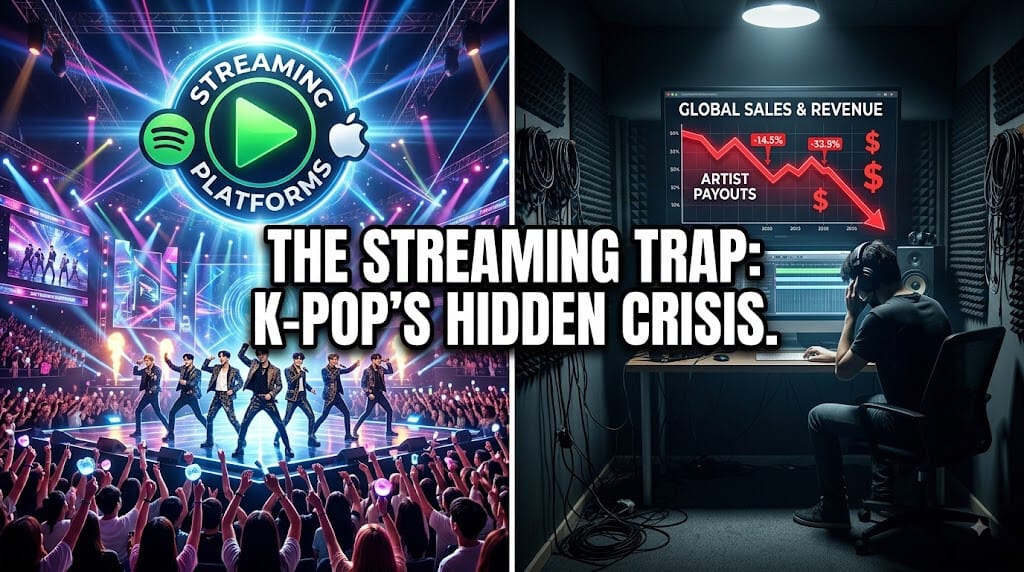
The global expansion of K-pop is undeniably one of the most fascinating cultural phenomenons of the 21st century. Fans from South America to Europe are streaming their favorite Korean artists on a daily basis, contributing to billions of digital plays worldwide. On the surface, the transition from physical CDs to global digital streaming platforms like Spotify and Apple Music seems like a massive win for the Korean music industry. It allows music to transcend borders instantly, theoretically giving every artist a fair shot at reaching a global audience without the need for traditional, expensive overseas distribution networks.
However, beneath this glittering facade of global accessibility lies a deeply flawed financial structure that threatens the very foundation of the K-pop ecosystem. While massive entertainment conglomerates—often referred to as the “Big 4″—reap the benefits of sheer volume, small to mid-sized K-pop agencies are quietly suffocating under the current streaming payout models. The mathematical reality of how global streaming giants distribute their revenues is heavily skewed against independent creators and smaller labels, creating an invisible ceiling that makes it nearly impossible for emerging K-pop groups to survive solely on their musical output.
The Illusion of the Pro-Rata Payout System
How the Revenue Pie is Divided
Most global streaming giants operate on a “pro-rata” or market-centric payment model. In simple terms, platforms pool all the subscription money generated in a specific region, take their roughly 30% cut, and distribute the rest to rights holders based on their overall share of total streams. If a megastar accounts for 5% of all streams on the platform, their label takes 5% of the total revenue pool. This means that a user’s $10 monthly subscription fee doesn’t necessarily go to the indie K-pop group they listen to all day; instead, a significant portion of their money is funneled to the top-charting mainstream artists they might have never even clicked on.
The Devastating Impact on Small K-Pop Labels
For a small K-pop agency that just debuted a new boy or girl group, this system is a financial nightmare. Producing a high-quality K-pop album, shooting a music video, and marketing the group requires an astronomical upfront investment, often running into millions of dollars. When the payout per stream is incredibly low—often less than a fraction of a cent per play—these smaller labels need tens of millions of streams just to break even. Unlike the top-tier agencies that can leverage massive established fandoms to dominate global streaming charts and secure a large slice of the pro-rata pie, smaller labels are left fighting for crumbs.
New Policies Making Survival Even Harder
Spotify’s 1,000-Stream Threshold
Recently, the streaming environment has become even more hostile for smaller players in the industry. Spotify introduced a new policy where a track must reach a minimum of 1,000 streams within a 12-month period to generate any royalties at all. While 1,000 streams might sound trivial for a mainstream pop star, it acts as a massive barrier for highly niche or newly debuted artists from smaller agencies struggling to find their footing. The revenue generated by tracks that fall under this threshold is essentially redistributed back into the overall pool, further enriching the massive artists at the very top.
Apple Music’s Premium Formatting Advantage
Similarly, Apple Music has begun offering up to 10% higher royalties for tracks mixed in Spatial Audio (Dolby Atmos). While this sounds like a great incentive for audio quality, it creates a severe structural disadvantage. Mixing and mastering tracks in Dolby Atmos requires highly specialized studios, expensive equipment, and top-tier sound engineers. Big K-pop labels can easily afford this premium production cost, automatically securing a higher payout rate for their artists. Meanwhile, small and mid-sized agencies, already operating on razor-thin margins, simply cannot afford the upgrade, meaning their standard stereo tracks earn inherently less on the exact same platform.
The Inevitable Shift Away from Music
Because the digital streaming ecosystem offers such a dismal return on investment, small K-pop agencies are forced to completely alter their business models just to survive.
Why Physical Albums and Merchandise Dominate
This harsh financial reality is exactly why the K-pop industry is so uniquely obsessed with physical album sales, random photocards, and expensive merchandise. Since a million streams might only yield a few thousand dollars, agencies have realized that selling physical items directly to a dedicated core fandom is the only reliable way to keep the lights on. The streaming platforms have effectively devalued the digital music itself, turning the actual songs into mere promotional tools designed to sell concert tickets, fan club memberships, and highly profitable physical goods.
Writer’s Opinion
Honestly, looking at how these massive streaming platforms operate, it’s just incredibly frustrating, right? I mean… we always talk about how K-pop is taking over the world globally, but if the actual financial system starves the smaller creators, are we really fostering diverse music? It just makes you wonder—if a super talented group from a tiny agency goes bankrupt despite having amazing songs, who really wins here? The whole ecosystem feels so rigged in favor of the corporate giants, and it’s kinda sad that the music itself doesn’t pay the bills anymore! It’s like, shouldn’t our subscription money actually go to the specific artists we listen to? It’s really bizarre how normalized this broken payout structure has become in the modern music era.