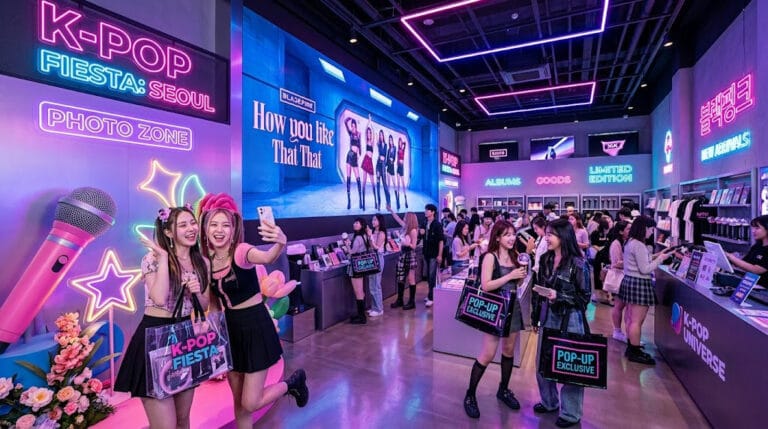
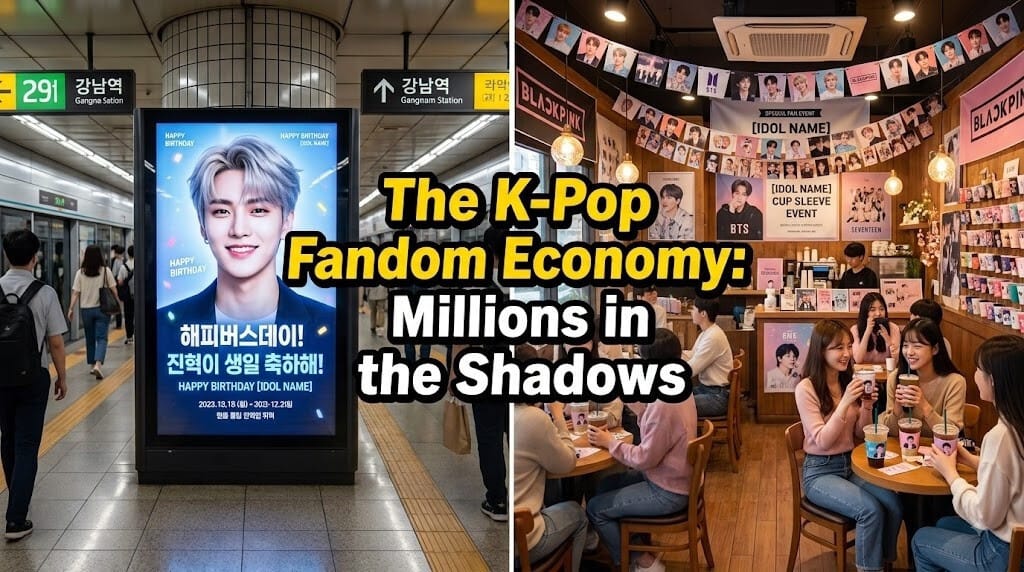
Walking through the vibrant streets of Seoul, particularly in districts like Hongdae, Gangnam, or Myeongdong, you are bound to encounter a spectacle that might seem perplexing to the uninitiated. Massive, brilliantly illuminated billboards in subway stations wishing a happy birthday to a young, attractive celebrity, or cozy local cafes completely transformed into shrines dedicated to a single pop star, complete with custom cup sleeves, banners, and photo exhibitions. This is not the work of a multi-million-dollar entertainment agency executing a carefully calculated marketing campaign. Instead, it is the result of a highly organized, deeply passionate, and financially potent group of individuals: the fans. What you are witnessing is the physical manifestation of the K-pop fandom economy, a sprawling, decentralized financial ecosystem that operates largely outside traditional corporate structures.
This phenomenon goes far beyond simply buying albums or concert tickets. The fandom economy represents a shift where consumers become active investors, promoters, and event organizers. Fans pool their resources, utilizing global crowdfunding methods to purchase premium advertising space, rent out commercial venues, and manufacture unofficial merchandise. This creates a massive “underground” or shadow economy that generates millions of dollars annually—revenue that never hits the balance sheets of the official entertainment companies. In this comprehensive guide, we will delve deep into the mechanics of this fandom-driven economics, exploring how idol birthday cafes and subway advertisements have birthed a shadow market of unprecedented scale, and what this means for the future of global pop culture consumption.
The Rise of Fandom-Driven Economics in K-Pop
What Exactly is the “Fandom Economy”?
The term “fandom economy” refers to the financial ecosystem built around the culture of passionate fans who spend considerable amounts of time, energy, and money on their favorite celebrities. In the context of K-pop, this economy has evolved into a highly sophisticated machine. Historically, being a fan meant purchasing official products—albums, concert tickets, and agency-produced merchandise. The relationship was strictly one-directional: the company produced, and the fan consumed. However, the modern K-pop landscape has completely disrupted this traditional model. Today, fans have transitioned from passive consumers to active producers, marketers, and stakeholders. They do not wait for entertainment agencies to promote their favorite idols; they take matters into their own hands. By organizing independent fundraising campaigns on platforms like Twitter (X), GoFundMe, and specialized Korean crowdfunding sites, fan bases can amass tens of thousands of dollars within days. This capital is then strategically deployed to maximize the idol’s public visibility and celebrate their milestones, thereby creating a robust, self-sustaining economic loop that runs parallel to the official industry.
The Scale of the Shadow Market
When we speak of an “underground” or shadow economy in this context, we are not referring to illegal black market activities. Rather, we are discussing the vast amount of unregulated, decentralized financial transactions that occur purely within the fan community. The scale of this market is staggering. While exact figures are difficult to pin down due to the decentralized nature of these transactions, industry insiders estimate that the K-pop shadow economy is worth tens of millions of dollars globally. This includes money spent on unofficial merchandise (often referred to as “fan-made goods” or “fansite merch”), domestic and international shipping logistics managed entirely by fans, independent cup sleeve events, and high-tier public advertising. This financial power gives fans a unique form of leverage. They are no longer just an audience; they are an autonomous economic force capable of influencing an idol’s public image and, consequently, their brand value. This shadow market operates on trust, mutual passion, and a shared goal of elevating the artist, making it one of the most unique economic models in the modern entertainment world.
Idol Birthday Cafes: More Than Just Coffee
The Business Mechanics of Birthday Events
One of the most prominent pillars of this fandom economy is the “idol birthday cafe” phenomenon. The business mechanics behind these events are a fascinating case study in symbiotic economic relationships. A fan base, often led by a dedicated “fansite master” or a committee of organizers, will approach a local independent cafe. The organizers propose to “take over” the cafe for a few days to a week around their idol’s birthday. The fans provide all the customized decorations: life-sized cardboard cutouts, framed photographs, custom paper cup sleeves, photocards, and stickers. In return for hosting the event, the cafe owner agrees to distribute these fan-made goodies with every drink purchased. For the cafe owner, this arrangement is an absolute goldmine. In a highly competitive coffee market like South Korea, a birthday event guarantees a massive, continuous influx of customers. Cafes that might normally sell 100 cups of coffee a day can easily sell over 1,000 cups daily during a popular idol’s event, leading to an incredible spike in revenue. The fans do not take a cut of the cafe’s profits; their sole reward is the successful execution of the event and the joy of celebrating their favorite star.
Social Hubs and Networking
Beyond the sheer economic transaction, these birthday cafes serve a crucial sociological function: they act as physical hubs for the fandom community. While K-pop fandoms are incredibly active in digital spaces, birthday cafes provide a rare, tangible environment where fans can interact in real life. These venues transform into networking hubs where attendees trade unofficial photocards, share stories, and build lasting friendships based on mutual interests. Furthermore, these cafes have become a vital part of the “fan pilgrimage.” International fans visiting South Korea often plan their entire travel itineraries around these cafe events, injecting foreign capital into local small businesses. This localized economic boost is entirely driven by the fandom. The cafes become temporary museums and safe spaces for fans to express their devotion freely. In this way, the birthday cafe is not just a place to buy coffee; it is a vital community center that reinforces fan loyalty and stimulates the grassroots economy of local neighborhoods.
Subway Ads: Billboards of Devotion
The High Cost of Public Declarations
If birthday cafes are the community centers of the fandom economy, subway advertisements are its grand monuments. Walking through major transfer stations like Samseong, Gangnam, or Hongik University, it is impossible to miss the towering digital screens and expansive lightboxes dedicated to K-pop idols. These ads celebrate birthdays, debut anniversaries, or even act as words of encouragement during a comeback or a scandal. The cost of these public declarations is substantial. Depending on the size, format, and location of the advertisement, renting a billboard in a high-traffic Seoul subway station can cost anywhere from $2,000 to over $10,000 per month. To fund these massive undertakings, fans mobilize on a global scale. International fanbases will often collaborate, pooling small donations from thousands of individuals across different continents. This micro-donation model democratizes the funding process, allowing a teenager in Brazil and an office worker in Japan to jointly finance a massive billboard in the heart of Seoul. It is a striking display of collective economic power, transforming public transit infrastructure into a canvas for global fan devotion.
The Evolution from Simple Posters to Digital Art
The nature of these subway advertisements has also evolved significantly, driving innovation within the advertising sector itself. What began years ago as simple printed posters has now transformed into high-definition digital video boards, interactive screens, and even fully immersive “media tunnels” where entire walkways are wrapped in floor-to-ceiling LED displays featuring the idol. Advertising agencies that manage subway spaces have created specific packages tailored entirely for fandoms, recognizing them as one of their most reliable and lucrative client bases. Moreover, these subway ads have become interactive landmarks. It is a common practice for fans to visit the ads, take photos with them, and post them on social media using specific hashtags. This creates a secondary wave of digital marketing that amplifies the idol’s visibility far beyond the physical location of the ad. Occasionally, the idols themselves will visit the subway stations late at night to take a picture with the ad, validating the fans’ efforts and fueling further spending in the future.
The “Underground” Economy of K-Pop Fandoms
Unofficial Merchandise and Cash Flows
A critical component of the fandom shadow economy is the production and distribution of unofficial merchandise. While entertainment companies sell official lightsticks, photo books, and apparel, fans crave more personalized, niche, and frequent merchandise drops. Enter the “fansite masters” and independent fan creators. These individuals take high-quality photos of idols at public schedules and use them to create photobooks, slogans, keychains, and plush dolls. They set up pre-orders online, collect funds, manufacture the goods in bulk (often utilizing factories in China or South Korea), and handle the complex logistics of international shipping. This process generates massive cash flows. A successful plush doll project, for instance, can generate tens of thousands of dollars in revenue. While much of this money is reinvested into the fandom—used to buy albums in bulk to boost chart rankings or to fund those expensive subway ads—it also creates a micro-economy where some fan creators can essentially make a living off their fandom activities. This decentralized commerce operates entirely on trust; fans send money to an anonymous social media account with the faith that they will receive a product months later.
Regulatory Gray Areas and Copyright Issues
This vibrant underground economy exists in a persistent regulatory gray area, particularly concerning intellectual property and copyright law. Technically, using an idol’s name, image, and likeness to produce and sell merchandise for profit—even if that profit is reinvested into fan projects—is an infringement of the entertainment agency’s copyrights. However, agencies usually turn a blind eye to these activities. The reason is simple: shutting down fan creators would alienate the most dedicated core of their consumer base and stifle the organic, free marketing that these fans provide. The unofficial merchandise, the birthday cafes, and the subway ads all serve to increase the idol’s popularity and brand presence at zero cost to the company. Therefore, a delicate, unspoken truce exists between the corporations and the fandoms. The agencies tolerate the shadow economy as long as it doesn’t cross the line into defamation or massive commercial exploitation that directly competes with official goods. This fragile balance is a unique characteristic of the K-pop industry, illustrating a highly modern approach to intellectual property in the age of participatory culture.
The Global Expansion of K-Pop Fan Economics
Exporting the Fandom Model
What started as a uniquely South Korean phenomenon has now become one of the country’s most fascinating cultural exports. As K-pop’s global footprint expands, so too does the fandom economy. Today, it is not just cafes in Seoul that are being transformed for idol birthdays. You can find fully decked-out K-pop birthday cafes in Tokyo, Bangkok, Jakarta, Los Angeles, and London. Similarly, the tradition of fan-funded public advertising has crossed oceans. K-pop fans regularly purchase billboard space in New York’s Times Square, on the sides of double-decker buses in the UK, and in major shopping malls across Southeast Asia. This globalization of the fandom economy demonstrates the immense soft power of Korean entertainment. It also shows how the economic behaviors of fans are transcending cultural and linguistic barriers. The methodology of organizing, fundraising, and executing large-scale projects has become a universal language among K-pop fans worldwide, creating a unified global shadow economy that moves millions of dollars across borders seamlessly.
The Future of Fan-Funded Markets
As we look to the future, the boundary between the official industry and the fandom shadow economy is beginning to blur. Recognizing the immense capital flowing through these unofficial channels, some entertainment companies and tech startups are attempting to institutionalize these behaviors. We are seeing the emergence of official apps that allow fans to “vote” and contribute money toward company-sponsored subway ads, essentially trying to capture the revenue that fans were previously spending independently. However, the success of these corporate attempts remains to be seen. The core appeal of the fandom economy is its grassroots, rebellious nature—it is a labor of love created by the fans, for the fans, without corporate oversight. If the industry tries to overly monetize or control these fan-led initiatives, they risk destroying the very passion that fuels them. The future of the fandom economy will depend on maintaining this delicate equilibrium: allowing fans the freedom to create and spend autonomously while agencies reap the secondary benefits of increased artist visibility and loyalty.
Writer’s Opinion
You know, looking at all these massive subway ads and fully decorated cafes… it really makes you wonder, who is actually running the K-pop industry? I mean, fans are practically doing the job of a whole marketing department, and they’re paying for the privilege with their own hard-earned cash! It’s just wild how a group of strangers on the internet can organize a $10,000 Times Square billboard in a matter of days—doesn’t it blow your mind? Sometimes I feel like this ‘shadow economy’ is more efficient than the actual agencies themselves. Sure, it’s a bit of a gray area legally, but maybe that’s exactly what makes it so powerful and genuine. It’s not just about spending money; it’s about claiming a stake in their idol’s success. Really makes you rethink what it means to be a “consumer” today, doesn’t it?