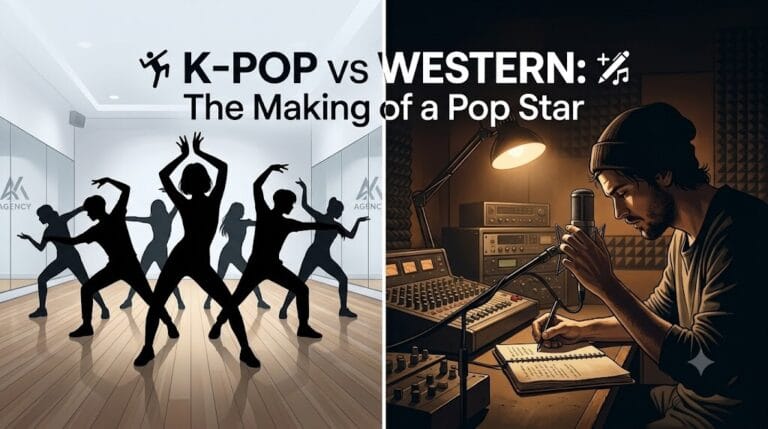
The K-pop industry is constantly evolving, seeking new ways to expand its global reach. Recently, a major shift has occurred with the introduction of global audition programs aimed at creating localized K-pop groups. Shows like JYP Entertainment’s A2K (America2Korea) and HYBE’s The Debut: Dream Academy are not just reality TV; they represent a strategic attempt to export the K-pop methodology directly into Western markets, aiming to build global pop groups from the ground up using the rigorous K-pop training system. This article explores how these programs have influenced the formation of groups like VCHA and KATSEYE, and what this means for the future of the music industry.
These programs essentially act as a bridge between the heavily structured world of Korean idol training and the diverse, independent spirit of Western pop. By broadcasting the entire process, these agencies are testing a fascinating hypothesis: Can the K-pop formula succeed when applied to non-Korean talent singing primarily in English? Let’s dive into how these audition shows are reshaping the landscape.

The Strategy Behind the Shows: “Globalization by Localization”
The core concept driving both A2K and Dream Academy is what J.Y. Park, founder of JYP Entertainment, calls “globalization by localization”. Historically, K-pop’s global strategy relied on exporting Korean artists who sang in Korean (with occasional English releases) to international audiences. The new strategy involves finding local talent in key markets, like the United States, and applying the K-pop development system to them.
A2K: The Search for the First American K-pop Group
JYP Entertainment, in partnership with Republic Records, launched A2K with the explicit goal of creating “the first American artist made out of a K-pop system”. The show followed young American contestants through regional auditions, an LA boot camp, and eventually to the JYP Training Academy in Seoul. The focus was heavily on the traditional pillars of K-pop training: vocal and dance coaching, language classes, and character evaluation. This systemic approach was designed to guarantee a certain level of polish and professionalism rarely seen in organically grown Western artists. The result was the six-member girl group VCHA, positioned as a global super group with deep roots in the K-pop methodology.
Dream Academy: A Global Search for Pop Stardom
HYBE and Geffen Records took a slightly different approach with The Debut: Dream Academy. They cast a wider net, accepting over 120,000 submissions globally. The 20 selected contestants, representing diverse countries like the US, Switzerland, the Philippines, and South Korea, underwent intensive training in Los Angeles. HYBE Chairman Bang Si-hyuk stated the intention was to form “an international group based on K-pop methodology”. The show, which later became the Netflix documentary Pop Star Academy: KATSEYE, highlighted the rigorous evaluations and the intense pressure of the trainee system. The resulting group, KATSEYE, embodies a diverse, global aesthetic while maintaining the synchronized precision expected of a HYBE group.
Building an Audience Before Debut
One of the most significant impacts of these audition programs is their ability to build a dedicated fanbase before the group even officially exists. This is a crucial element of the K-pop playbook, but applying it to a Western audience via reality TV and streaming platforms like YouTube and Netflix is a powerful innovation.
The Reality TV Effect
By showcasing the struggles, growth, and personalities of the contestants over several weeks, fans become emotionally invested in the journey. They aren’t just listening to a new song; they are rooting for the individuals they watched train for months. Dream Academy utilized fan voting alongside expert judging, giving the audience a direct stake in the final lineup. This creates a ready-made, highly engaged fandom—a massive advantage in the competitive pop music landscape.
Transparency vs. The Traditional K-pop Mystique
While traditional K-pop debuts often rely on presenting a polished, almost perfect final product, shows like A2K and Dream Academy (and especially the Pop Star Academy documentary) offer a raw look behind the curtain. They expose the grueling reality of the trainee system, which appeals to a Western audience that values authenticity and “behind-the-scenes” access. This transparency helps fans connect with the members on a deeper level, understanding the immense effort required to achieve that polished final performance.
The Output: Hybrid Groups and Market Impact
The groups formed from these programs, like VCHA and KATSEYE, represent a fascinating hybrid. They are not strictly “K-pop” in the traditional sense, as they sing primarily in English and target the global (specifically Western) market first. However, their foundation is undeniably built on the K-pop methodology.
A New Standard for Pop Groups?
These groups challenge the traditional Western model of artist development, which often relies on organic discovery and individual hustle. By introducing the intense choreography, coordinated concepts, and systematic training of K-pop, they are setting a new, very high standard for what a pop group should look and sound like. It forces the Western industry to reconsider how it develops talent.
The Success and the Struggle
The success of these groups is still unfolding, and the results have been mixed. KATSEYE has seen significant momentum, charting on the Billboard 200 and gaining a massive global following, partly fueled by the success of their Netflix documentary. VCHA, on the other hand, despite being formed through A2K, has struggled to make a similar impact on global charts, leading to questions about the different strategies employed by HYBE and JYP. This divergence highlights that while the K-pop methodology is powerful, it is not an automatic guarantee of success in the complex Western market. The nuance of the rollout, the music itself, and the continued engagement strategy are just as critical.
Writer’s Opinion
So, are these audition shows the future of pop music, or just a very expensive experiment? It is undeniable that the K-pop system creates incredibly polished performers, but applying that rigid structure to a Western market that prizes raw authenticity is a massive gamble. The fact that KATSEYE is charting while VCHA struggles shows that the idea of a localized group isn’t enough; the execution has to be flawless. It makes you wonder if we are witnessing the birth of a entirely new genre of “Global Pop,” or just a temporary crossover trend. Watching these two vastly different music cultures collide in real-time is fascinating.