When global music powerhouses like Coachella and Lollapalooza announced K-pop acts as their primary headliners and mainstage performers, the music world witnessed a massive paradigm shift. Iconic sets from groups like BLACKPINK, Stray Kids, ATEEZ, and NewJeans demonstrated that Korean music was no longer a niche subculture, but a dominant force on the global festival circuit. For entertainment agencies, booking a headlining slot at a historic festival represents the ultimate validation of an artist’s cultural impact and global reach.
However, behind the spectacular pyrotechnics, viral clips, and packed festival grounds lies a complex financial calculation. While fans see a historic milestone, corporate executives and Chief Financial Officers see a high-stakes balance sheet trade-off. When compared to the predictable, high-margin revenue of an exclusive solo world tour, taking the stage at a multi-genre rock and pop festival introduces unique financial risks, capped upfront payouts, and massive production overhead. Examining how entertainment agencies balance the immediate profits of solo touring against the long-term strategic branding of festival headlining reveals the true financial mechanics of the modern music industry.
The Financial Reality: Solo World Tours vs. Festival Appearances
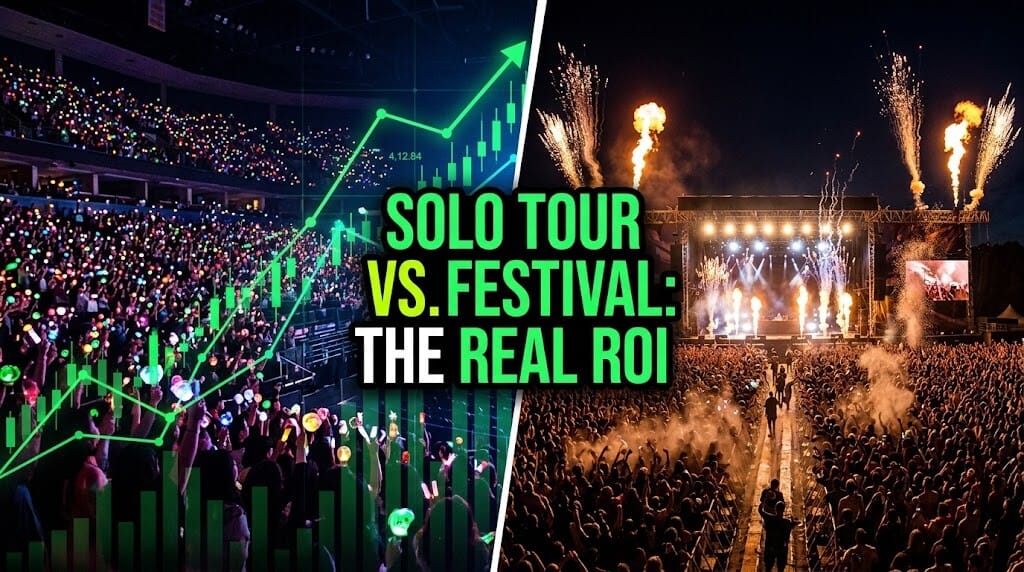
To understand why an agency would send its prized group to a festival, one must first analyze how money is made in the live music ecosystem. The financial architecture of a solo arena or stadium tour is fundamentally different from a single festival appearance.
Solo World Tours: The High-Margin Cash Cow
Solo world tours are the primary profit engines for major music agencies. When an artist sells out a 20,000-seat arena or a 50,000-seat stadium, the agency controls nearly every revenue stream. Ticket prices are dynamically priced to maximize yield, VIP meet-and-greet packages command premium rates, and merchandise sales belong almost entirely to the artist and agency.
Furthermore, tour logistics scale efficiently over time. Once a stage design, lighting grid, and video routine are built and rehearsed, the cost per show decreases significantly across a 30-date or 50-date tour schedule. The agency collects tens of millions of dollars in net profits, with predictable margins and a captive audience composed entirely of paying, dedicated fans.
Major Festivals: High Investment, Capped Upfront Fees
In contrast, festival performance contracts operate under a completely different financial framework. Festival promoters offer a flat performance guarantee or a set fee structure to headliners. While this fee can range from hundreds of thousands to a few million dollars for top-tier acts, it rarely matches the gross earnings of two or three nights on a solo stadium tour.
Additionally, top-tier artists at festivals like Coachella or Lollapalooza are expected to deliver a custom, stadium-worthy show. This requires bespoke stage setups, tailored lighting design, specialized live band arrangements, and massive travel operations for dozens of dancers, technicians, and stylists. Because these custom elements are often used for only one or two festival weekends, the fixed costs cannot be amortized over a long tour, drastically compressing immediate profit margins.
Strategic Branding and Non-Financial ROI
If solo tours generate superior short-term margins, why do entertainment agencies fight so aggressively for festival slots? The answer lies in long-term brand equity and demographic reach.
Breaking Outside the Fandom Bubble
A solo tour preaches to the converted. Every person in a stadium during a solo tour is already a dedicated fan who buys albums, streams tracks, and purchases merchandise. While this is ideal for immediate monetization, it does not naturally expand the artist’s consumer base.
Global festivals, on the other hand, offer exposure to tens of thousands of casual music lovers, music critics, industry insiders, and fans of other genres. Performing in front of a diverse crowd creates a unique discovery funnel. Captivating an indifferent or curious festival audience converts casual listeners into loyal fans, dramatically expanding the long-term addressable market for the artist’s future releases.
The “Headliner Status” Credibility Boost
Headlining a globally recognized festival bestows an intangible halo effect on an artist’s brand value. It signals to international brands, luxury fashion houses, and global media outlets that the artist has achieved mainstream cultural relevance.
This elevated prestige directly translates into lucrative non-touring revenue streams:
- Global Endorsements: High-fashion ambassadorships and international brand deals command significantly higher rates for proven festival headliners.
- Higher Future Tour Guarantees: Venue promoters worldwide increase their guarantees and venue sizes for acts with proven festival headliner credentials.
- Mainstream Media Coverage: Festival performances generate mainstream press coverage from global publications that rarely cover standard idol tour stops.
Dissecting the Balance Sheet: Cost Breakdown & Long-Term Revenue
Evaluating the festival balance sheet requires agencies to look beyond immediate event income statement items and consider deferred financial returns.
Immediate Expenses vs. Deferred Profitability
A simplified cost-benefit breakdown demonstrates how immediate festival losses or thin margins turn into long-term corporate gains:
| Financial Category | Solo World Tour | Major Festival Headliner |
| Primary Revenue | Ticket Sales & Exclusive Merch | Fixed Artist Guarantee / Flat Fee |
| Production Overhead | Amortized across 30+ dates | High fixed cost for 1-2 dates |
| Audience Target | Existing, dedicated fandom | Mass market & industry insiders |
| Streaming Impact | Moderate bump among fans | Massive global streaming spike |
| Immediate Profit Margin | High (25% – 40%+) | Low to Breakeven (0% – 15%) |
While the immediate profit margin for a festival appearance might look unimpressive on a quarterly financial report, the deferred profitability often offsets the initial sacrifice.
Case Studies: The Post-Festival Multiplier Effect
Historical streaming and social media metrics show that a successful festival performance acts as a massive global marketing campaign. Following high-profile festival sets, artists consistently experience exponential surges in Spotify monthly listeners, YouTube view counts, and Shazam searches.
This surge in digital engagement triggers algorithmic placement across major streaming platforms, yielding sustained recording and publishing royalties for months after the event. Furthermore, when the artist subsequently announces their next world tour, ticket demand frequently explodes in regions where the festival set was broadcast or discussed online. The festival appearance functions as a highly effective, self-funded global promotional tour.
Strategic Verdict: Balancing the Portfolio
For a modern entertainment agency managing top-tier talent, the optimal approach is not choosing between solo tours or festivals, but strategically balancing both.
A festival headlining slot should be viewed as an R&D and marketing investment. By sacrificing peak short-term margins at a festival, the agency acquires new fans, establishes mainstream cultural authority, and elevates the artist’s global prestige. Once that elevated status is secured, the agency immediately monetizes it by launching a massive, high-margin solo world tour. In the long-run financial calculus of global music, major festivals are the ultimate engine for long-term enterprise value.
Writer’s Opinion
Is burning through millions of dollars for a single hour-long festival set really worth the hit to an agency’s quarterly profit margins? Honestly, when you look at the sheer chaos of festival logistics, custom staging, and tiny net payouts, it almost seems completely irrational on paper, right? But then you see thousands of casual rock and pop fans waving lightsticks and screaming lyrics in the middle of a desert, and it all suddenly clicks! Isn’t it wild how a single 60-minute performance can completely pivot an artist’s narrative from “regional idol” to “global rockstar” and drive stock prices up? I guess sometimes you just have to burn a little cash today to build an absolute empire tomorrow—what do you think?