If you have ever watched a K-pop fan unbox a brand new album, you know that the actual CD is often an afterthought. The true prize, the moment of breathless anticipation, lies hidden between the glossy pages of the photobook: a piece of printed cardboard measuring exactly 5.5 by 8.5 centimeters. These are K-pop photocards, and to the uninitiated observer, they are simply cute collectibles. However, step inside the intricate web of global K-pop fandoms, and you will quickly realize that these small pieces of paper have transcended their original purpose as promotional merchandise.
Within the K-pop ecosystem, photocards have evolved into a highly complex, decentralized financial system. They function as a legitimate alternative currency, complete with fluctuating exchange rates, inflation, market manipulation, and strict trading etiquette. The sociology of photocard exchange offers a fascinating glimpse into how modern fandoms organize themselves, create value out of artificial scarcity, and establish a shadow economy fueled by emotional attachment and digital connectivity. Understanding this phenomenon requires looking beyond the music and diving deep into the sociological mechanisms that drive fan culture today.
The Evolution of the Photocard Economy
The concept of inserting randomized trading cards into music albums is not entirely new, but the K-pop industry has optimized it into a masterclass of consumer psychology. What started as a fun bonus has become the central pillar of album sales.
The Mechanism of Artificial Scarcity
The foundational rule of any currency is that its value relies on scarcity and demand. Entertainment agencies manufacture scarcity through the “blind box” or “gacha” mechanic. An album might have a dozen different photocard variations per member, and with groups sometimes boasting over ten members, the mathematical probability of a fan pulling their favorite member—their “bias”—is remarkably low. This deliberate artificial scarcity forces fans to buy albums in bulk to increase their odds, injecting massive amounts of inventory into the fandom market and kickstarting the trading economy.
Establishing the Alternative Currency
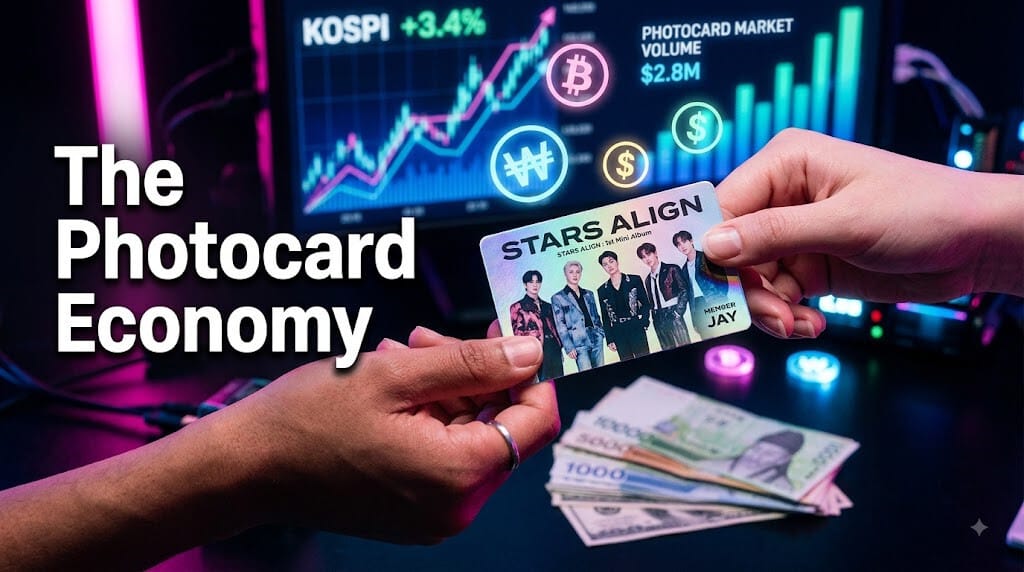
Once the albums are opened, the secondary market comes alive. Photocards become the accepted medium of exchange. Fans do not just trade card for card; they use highly sought-after cards to barter for concert tickets, exclusive fan-meeting slots, or rare out-of-print merchandise. In this closed ecosystem, fiat currency like dollars or won sometimes takes a back seat to the intrinsic value of a rare, limited-edition holographic card. The card itself holds stored value, universally recognized and agreed upon by the members of the fandom community.
The Sociology of Trading and Fandom Hierarchy
The photocard market is not a chaotic free-for-all; it is governed by strict, unwritten sociological rules that dictate how community members interact, negotiate, and build trust.
Exchange Rates and Member Valuation
One of the most controversial yet undeniable aspects of the photocard economy is the concept of “member pricing.” In this alternative market, not all cards are created equal, even if they cost the exact same amount to produce. A photocard’s market value is directly tied to the popularity of the idol pictured on it. This creates a floating exchange rate. A fan might need to trade three cards of a less popular member to acquire one card of the group’s most popular member. This dynamic creates a distinct social hierarchy within the trading community, where holding “high-value” members grants a fan more purchasing power and leverage in negotiations.
Trust, Reputation, and Community Cohesion
Because this alternative currency operates mostly across social media platforms like X (formerly Twitter), Instagram, and specialized trading apps, trust is paramount. The sociology of the exchange relies heavily on digital reputation. Traders build credibility through “proofs”—screenshots of successful past trades, tracking numbers, and highly specific packaging videos. A scammer who fails to send a card is quickly blacklisted and ostracized from the community. Therefore, the act of trading is not just an economic transaction; it is a social ritual that reinforces community boundaries, establishes mutual trust, and binds fans together through a shared set of norms and values.
The Dark Side of the Cardboard Economy
While the trading culture can foster a strong sense of belonging, it also brings significant psychological and financial stress, mimicking the pitfalls of real-world capitalist systems.
Inflation and Capitalist Burnout
As agencies release an increasing number of exclusive cards—from pre-order benefits (POBs) to lucky draws and regional exclusives—the market becomes saturated, yet the demand for completion remains impossibly high. This drives hyper-inflation within the photocard economy. Rare cards can sell for hundreds, sometimes thousands, of dollars. The pressure to maintain a complete collection can lead to immense financial strain and “fandom burnout,” where the joy of supporting an artist is overshadowed by the stressful, competitive nature of accumulating cardboard wealth.
Writer’s Opinion
Honestly, stepping back and looking at this whole photocard phenomenon really makes my head spin… are we all just collectively hallucinating value into existence? I mean, we are talking about paying rent-level prices for a literal two-inch piece of printed cardboard! It sounds completely absurd to anyone on the outside, doesn’t it? But then again, when you think about it, isn’t that exactly how normal money works anyway? It only has value because we all agree it does. Still, watching a teenager negotiate a three-way cross-country trade with military precision just to get a selfie of their bias makes you realize… human psychology and our desperate need to collect things is just wild!