The global explosion of K-pop is often celebrated for its dazzling aesthetic perfection—flawless choreography, breathtaking visual effects, and music videos that look like high-budget sci-fi blockbusters. When a top idol group drops a new teaser at midnight, millions of fans instantly flood social media to praise the “cinematic universe” and visually intoxicating concepts. But behind those shiny, pixel-perfect three-minute videos lies a very dark, rarely discussed reality: the brutal digital sweatshops powered by freelance post-production artists.
While the world cheers for the idols on screen, the unseen visual laborers—specifically freelance CG designers, 3D artists, and music video editors—are trapped in what the tech and gaming industries call “crunch mode.” In the final weeks leading up to a major K-pop comeback, these silent creators endure inhumane working schedules, crippling emotional pressure, and questionable financial treatment just to hit impossible deadlines. Let’s pull back the neon-lit curtain to examine the grueling crunch culture of K-pop’s visual workforce, the structural labor abuses of the agency-subcontractor pipeline, and why the shiny world of music video post-production is desperately crying out for reform.
The Brutal Anatomy of a K-Pop “Comeback Crunch”
In the software and gaming industries, “crunch” refers to mandatory, prolonged overtime required to finish a project before launch. In the K-pop industry, however, crunch isn’t an occasional sprint; it is an integrated, permanent business model designed to serve strict corporate marketing calendars.
The Midnight Teaser Deadline Trap
A K-pop album release is a tightly orchestrated military operation. Entertainment agencies announce comeback schedules weeks in advance, locking in specific dates for concept photos, music video teasers, and the final premiere. But here is the catch: post-production teams are almost always handed the raw footage dangerously late.
- Compressed Timelines: A music video that requires two months of intensive CGI, color grading, and VFX compositing is regularly compressed into a two-week—or even seven-day—nightmare.
- The 11:59 PM Panic: Because labels drop teasers at midnight KST to maximize global social media algorithms, editors frequently render files at 11:45 PM, praying their hard drives don’t crash before the upload goes live.
- Zero Margin for Error: Unlike software that can be patched after release, a music video must be 100% flawless the second it goes public, intensifying the psychological torment on the editors.
Why Freelancers Bear the Heaviest Burden
Most major entertainment labels don’t maintain massive in-house VFX and editing departments. Instead, they outsource production to independent production houses, which then subcontract the heaviest digital lifting to freelance artists.
- No Labor Law Protections: As independent contractors, freelance CG artists and editors fall outside standard labor laws that limit weekly working hours or guarantee overtime pay.
- The Fear of Being Blacklisted: The K-pop visual industry is a surprisingly small, hyper-competitive ecosystem. Turning down a sudden midnight revision or complaining about an unrealistic deadline often means being quietly erased from future project rosters.
- Isolation in the Studio: While on-set crew members at least work as a physical team, post-production freelancers often suffer alone in dark home offices, glued to monitors for days without real human contact.
The Physical and Mental Fallout of 100-Hour Workweeks
What does a K-pop comeback crunch actually look like for a freelance visual artist? It looks less like a creative studio and more like a medical emergency waiting to happen. The physical toll of sitting in front of dual monitors for 100 to 120 hours a week is nothing short of devastating.
The “Sleepless Studio” Syndrome
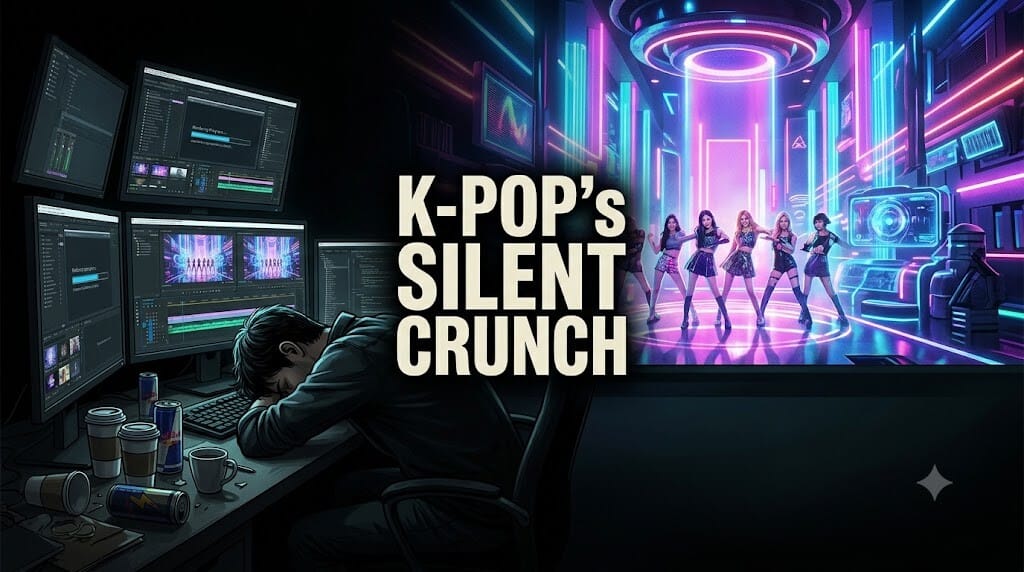
During the final seven days before a music video premiere, sleep ceases to be a daily routine and becomes a series of fifteen-minute naps under an office desk while a heavy 4K video file renders.
- Chronic Sleep Deprivation: Editors routinely pull seventy-two-hour awake benders, relying on energy drinks, espresso, and sheer adrenaline to keep their eyes open.
- Severe Musculoskeletal Trauma: Carpal tunnel syndrome, cervical spine disc herniation (turtle neck syndrome), and chronic lower back pain are considered unavoidable badges of honor in the VFX community.
- Vision Degenerative Symptoms: Staring at high-contrast color grading monitors in pitch-black rooms for days on end causes chronic dry eyes, visual blurring, and intense ocular migraines.
The Psychological Decay of Creative Labor
Beyond the physical wreckage, the mental health of visual laborers is continuously eroded by the perfectionist demands of both label executives and hyper-vigilant fandoms.
- Micro-Management by Committee: An editor might spend twenty hours perfecting a 3D sci-fi background, only for a label executive to reject it via text message at 3:00 AM because an idol’s face “doesn’t look bright enough.”
- The Fandom Pressure Cooker: K-pop fans analyze every single frame of a music video. If a CGI artifact is left in the corner of the screen, fans screenshot it, mock the production quality online, and accuse the team of “sabotaging” their favorite group—oblivious to the fact that the editor hadn’t slept in four days.
Toxic Economics: Low Pay, Late Revisions, and Wage Theft
If the working conditions are this grueling, the financial compensation must be astronomical, right? Sadly, the economic reality of K-pop post-production is often as grim as the hours are long.
The Predatory Structure of “All-Inclusive” Contracts
Most freelance CG designers and MV editors are hired on a flat-rate project fee rather than an hourly wage. In theory, this rewards efficiency; in practice, it is a mechanism for unlimited unpaid labor.
- The Endless Revision Loop: Contracts rarely cap the number of revisions. Label directors routinely demand “just one more small change” five, ten, or twenty times without paying a single extra dollar.
- Uncompensated Scope Creep: A project that starts as a “simple color correction” often snowballs into full-scale 3D asset creation and digital set extension without any corresponding adjustment to the budget.
- Delayed Payment Cycles: Freelancers are frequently forced to wait anywhere from three to six months after a video hits 100 million YouTube views just to receive their original flat-rate paycheck.
Why “Credit Exposure” Doesn’t Pay the Bills
The industry thrives on the exploitation of passion and prestige. Freelancers are repeatedly told that having a chart-topping K-pop idol group on their showreel is worth more than money.
| Treatment Metric | Standard Corporate Industry | K-Pop Freelance Visual Labor |
| Overtime Compensation | 1.5x to 2.0x hourly pay rates | $0 (Included in flat project fee) |
| Revision Limits | Explicitly capped in contract | Infinite until client is satisfied |
| Work-Life Balance | Guaranteed weekends & evenings | 24/7 on-call availability required |
| Payment Terms | Net-30 or immediate invoicing | Often delayed 90 to 180 days |
Reforming the Shadows of the K-Pop Industry
How long can a global multi-billion-dollar industry build its visual empire on the broken backs of exhausted freelancers? As Korean pop culture continues to dominate global entertainment, the ethical spotlight must finally shift from the stage to the editing room.
Building Sustainable Pipeline Standards
To protect the workforce that makes K-pop visually captivating, both entertainment agencies and production studios must adopt structural reforms immediately.
- Standardized Contract Caps: Industry-wide contracts must explicitly define maximum revision limits, charging premium overtime rates for any client changes requested within forty-eight hours of a release deadline.
- Realistic Post-Production Windows: Record labels must factor digital rendering and VFX timelines into their marketing calendars, giving artists weeks—not days—to execute complex CGI concepts.
- Fair Wage and Prompt Payment Systems: Establishing mandatory Net-30 payment regulations to ensure independent visual creators are paid fairly and promptly for their labor.
The Collective Responsibility of the Industry
Ultimately, the beauty of a music video should never come at the cost of a human being’s health. The idols who sing about self-love and mental health would likely be horrified to know what the editors cutting their videos endure in the dark. It is time for K-pop to mature from a fast-paced factory into a sustainable, ethical creative ecosystem.
Writer’s Opinion
You know what really gets me about all this? We sit there watching these stunning, jaw-dropping three-minute music videos, screaming over how cool the CGI dragons or floating cities look—but do we ever stop to think about the guy who stayed up for four straight days on energy drinks just to render that five-second clip? Honestly, it’s kinda heartbreaking, isn’t it?! The whole “do it for the K-pop portfolio” excuse is just modern-day exploitation dressed up in glitter. Like, I get it, deadlines are deadlines… but shouldn’t a multi-billion dollar industry be able to afford sleep for its workers? I really hope fans start caring as much about the artists behind the screen as they do about the idols on it, because this bone-crushing crunch culture just can’t last forever!