
We all cheered when the music industry finally started taking environmental sustainability seriously. For decades, our love for music meant mountains of plastic waste. From millions of cassette tapes clogging up landfills to polycarbonate CDs wrapped in layers of unrecyclable shrink wrap, the physical music era was a documented ecological disaster. So, when the industry pivoted to digital streaming and introduced the innovative “platform album”—a sleek, plastic-free package containing just a photocard and a QR code or NFC tag—it felt like a massive victory for the planet. Fans could support their favorite artists, collect the merchandise they loved, and consume the music digitally without feeling guilty about contributing to the global plastic crisis. It was marketed as the ultimate eco-friendly solution, perfectly aligning with modern ESG (Environmental, Social, and Governance) goals.
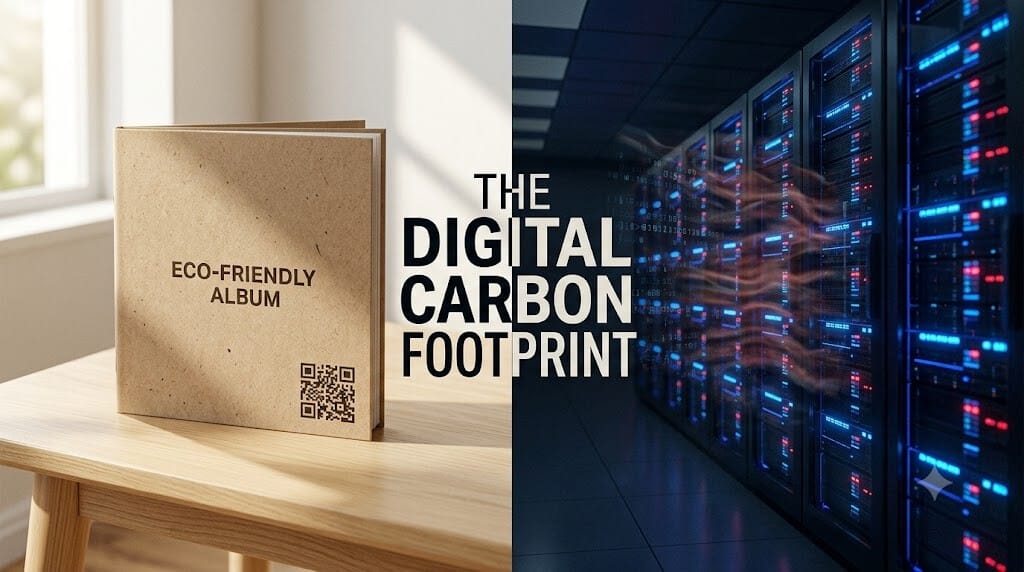
But there is a hidden, invisible cost to this supposedly green revolution, and it is quietly becoming one of the most pressing environmental issues of our modern digital age. We have been conditioned to think of the internet as an ethereal, weightless space. We call it “the cloud,” a term that evokes images of fluffy, harmless vapor floating in the sky. In reality, the cloud is heavily tethered to the ground. It consists of millions of physical servers housed in massive, warehouse-sized data centers spread across the globe. These servers run twenty-four hours a day, seven days a week, demanding staggering amounts of electricity not just to process and transmit data, but to keep the machines cool enough to prevent them from melting down. By swapping physical plastic for digital downloads and continuous streaming, we haven’t eliminated our environmental impact; we have simply traded visible plastic waste for an invisible, yet rapidly growing, digital carbon footprint.
The Illusion of the Eco-Friendly Platform Album
The rise of the platform album, particularly within the heavily merchandise-driven global pop and K-pop industries, was born out of a genuine desire to reduce plastic production. However, understanding why this solution is paradoxical requires a deep dive into how these albums function and how consumer behavior drives digital emissions.
What Exactly is a Platform Album?
A platform album is essentially a minimalist physical release. Instead of a jewel case and a shiny polycarbonate disc, buyers receive a small paper envelope. Inside, they typically find a collectible photocard and a digital access code—often a QR code or an NFC-enabled smart card. By scanning this code with a smartphone, the user is directed to a proprietary application where they can stream the music, download digital photobooks, and watch exclusive high-definition video content. On paper, it looks incredibly sustainable. The physical footprint is drastically reduced, shipping weights are lowered (meaning fewer transportation emissions), and the reliance on raw fossil fuels to create CDs is virtually eliminated.
The Hidden Environmental Cost of Digital Goods
The problem arises when we look at the lifecycle of digital consumption. When you scan that eco-friendly QR code, your phone sends a signal through your local Wi-Fi or cellular network, down through fiber-optic cables, potentially across oceans via undersea wires, until it reaches a massive data center. That data center then retrieves the high-resolution audio files, the 4K exclusive videos, and the digital booklets, and sends them all the way back to your device. This complex journey requires electricity at every single step. Every router, switch, cellular tower, and server involved in the transaction consumes power. When millions of fans simultaneously access these digital platform albums on release day, the sudden spike in energy demand is astronomical. The plastic may be gone, but the carbon emitted from burning fossil fuels to power those data centers is very real.
The Streaming Paradox: Why the Cloud is an Energy Monster
To understand the sheer scale of the digital carbon footprint, we have to compare the era of physical media to the era of endless streaming. A groundbreaking study by the University of Glasgow and the University of Oslo highlighted this exact paradox: while the amount of plastic used by the music industry has plummeted since the year 2000, the greenhouse gas emissions associated with music consumption have actually increased.
The Lifecycle of a CD vs. The Endless Loop of Streaming
Let’s look at the math of music consumption. Manufacturing a physical CD has a high upfront environmental cost. You have to extract oil, refine it into plastic, press the disc, print the paper inserts, and physically ship it to a store or a fan’s house on a gas-guzzling truck. However, once that CD is sitting on a shelf, its carbon footprint drops to almost zero. If you put that CD into a local CD player and listen to it a thousand times, the only energy used is the minimal electricity required to spin the disc in your home.
Streaming, on the other hand, operates on a continuous energy-drain model. Every single time you press play on a streaming platform like Spotify, Apple Music, or a proprietary platform album app, the data must be retrieved from the server and transmitted to your phone all over again. Studies suggest that if you listen to a specific song or album more than roughly twenty to twenty-seven times, streaming that digital file actually consumes more energy and produces more carbon emissions than if you had just manufactured and shipped a physical CD.
The Impact of 24/7 Streaming Culture
This continuous energy drain is exacerbated by modern fan culture. Today, music is rarely just listened to; it is consumed in the background. People leave playlists running while they sleep to help them relax. Furthermore, in highly competitive fanbases, “stream farming” has become a massive trend. Fans will set up multiple devices—phones, tablets, computers—and let their favorite artist’s new album play on a silent, endless loop twenty-four hours a day to artificially boost chart rankings and streaming numbers. While this shows immense dedication, it is an absolute nightmare for the environment. These silent streams are constantly pulling data from server farms, churning through terabytes of bandwidth, and generating massive amounts of CO2 for music that no one is actually hearing.
Inside the Data Center: The Physical Reality of the Internet
To fully grasp the digital carbon footprint, we must pull back the curtain on the infrastructure of the internet. The data centers required to keep global streaming platforms and digital album apps running flawlessly are industrial behemoths.
Server Farms and the Battle Against Heat
A modern data center can be as large as multiple football fields, filled floor-to-ceiling with racks of powerful computers. Processing millions of simultaneous streams generates an incredible amount of heat. If these servers are not constantly cooled, they will overheat, crash, and cause massive internet outages. Therefore, up to forty percent of the energy consumed by a data center goes purely toward air conditioning and liquid cooling systems. In some regions, data centers consume millions of gallons of fresh water daily just to keep the ambient temperature down.
The Renewable Energy Gap
Tech giants and streaming platforms are quick to defend themselves by claiming they are transitioning to renewable energy. Many proudly state that their operations are powered by wind, solar, or hydroelectric power. While these efforts are commendable and absolutely necessary, they often mask the broader reality of the global energy grid. The demand for data storage and digital transmission is growing exponentially, far outpacing the speed at which renewable energy infrastructure can be built. Consequently, many data centers are still deeply reliant on local power grids that burn coal or natural gas. Even when companies purchase carbon offsets or renewable energy certificates, the actual physical electrons powering their servers at any given moment may still be coming from fossil fuels.
Greenwashing in the Modern Music Industry
With all of this data in mind, we have to ask a difficult question: is the shift to platform albums and purely digital releases a genuine environmental effort, or is it a form of corporate greenwashing?
Greenwashing occurs when a company spends more time and money marketing themselves as environmentally friendly than actually minimizing their environmental impact. When a record label releases an “eco-friendly” platform album, they gain positive public relations for reducing plastic. However, they often release these digital albums in multiple collectible versions to encourage bulk buying. A fan might buy twenty copies of the “digital” album just to collect all the different physical photocards included in the paper envelopes.
The result? The record label still mass-produces paper and physical merchandise, the fan still generates shipping emissions to receive the physical photocards, and now, a massive digital carbon footprint is added on top of it all because the fan must use cloud servers to access the music. The pollution hasn’t been eliminated; it has just been fragmented and hidden behind a digital interface.
How Conscious Listeners Can Reduce Their Digital Carbon Footprint
The goal is not to shame anyone for streaming music or buying platform albums. The digital age has democratized music and made art infinitely more accessible to the global population. However, as consumers, we can adopt better digital hygiene to mitigate our invisible environmental impact.
Embrace Local Downloading over Constant Streaming
The most effective way to reduce your digital carbon footprint is to change how you interact with your favorite apps. Instead of streaming your favorite playlist directly from the cloud every single day, use the “download for offline listening” feature provided by almost all major streaming services. By downloading the tracks via Wi-Fi to your phone’s internal storage, you only pull the data from the massive server farms once. Every time you listen after that, the music plays locally, cutting the carbon emissions of your listening habits drastically.
Reconsider Audio Quality Settings
Do you really need to stream a podcast or background lo-fi beats in lossless, ultra-high-definition audio? High-fidelity audio files are massive. They require significantly more bandwidth to transmit than standard compressed audio files. By diving into your streaming app’s settings and lowering the audio quality for casual, daily listening—especially when listening on standard earbuds where you likely won’t hear the difference anyway—you can drastically reduce the amount of data moving through the network.
The Surprising Case for Keeping Physical Media
Ironically, if you have an absolute favorite album that you know you will listen to hundreds of times over the next few years, the most environmentally friendly choice might actually be to buy it on vinyl or CD. Purchasing physical media once and playing it locally for years is a highly sustainable model of consumption, provided you don’t throw the item away.
The transition away from single-use plastics in the music industry was a necessary and vital step forward. However, as we rush headfirst into an entirely digital future, we must remain vigilant. True sustainability is not just about changing the physical materials we consume; it is about understanding the complex, hidden infrastructures that power our modern conveniences. The digital carbon footprint of our music habits is a silent crisis, and solving it will require both corporate accountability and a shift in our everyday digital consumption.
Writer’s Opinion
Wait, so let me get this straight… I completely ditched my massive CD collection because I thought I was saving the planet, and now you’re telling me my midnight lo-fi Spotify playlist is secretly heating up some giant server farm in the middle of nowhere? It’s honestly kind of mind-blowing, isn’t it? We all patted ourselves on the back for getting rid of those bulky plastic cases, but it feels like we just traded visible trash for invisible pollution. I mean, who would have thought that a tiny QR code “eco-album” could actually be worse for the earth if a fanbase streams it a million times on mute? It really makes you second-guess everything that slaps an “eco-friendly” sticker on its packaging these days. The cloud is just someone else’s computer burning electricity—makes you want to dig out the old Walkman, doesn’t it?