When you listen to a chart-topping K-pop track today, you might assume you are hearing a purely Korean creation. The reality, however, is far more complex and globally intertwined. Behind the highly synchronized choreography, dazzling music videos, and flawless vocals lies a hidden, multinational engine driving the industry’s explosive growth. It is a system that treats songwriting not as a solitary moment of inspiration, but as a meticulously orchestrated global summit.
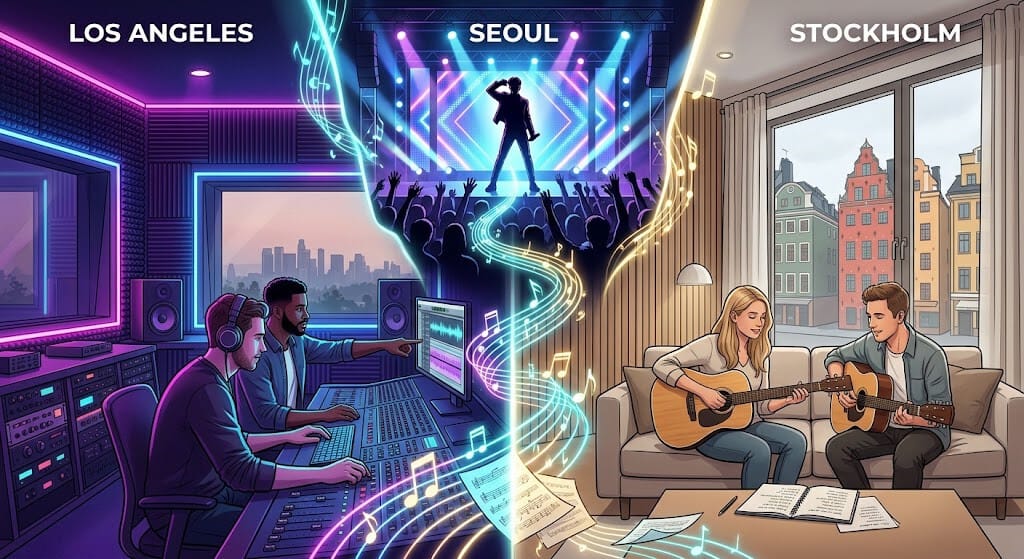
This engine is known as the “song camp,” a highly specialized, intense creative workshop where top-tier producers and writers from around the world converge. Entertainment agencies in Seoul regularly invite creators from Stockholm, Los Angeles, London, and beyond to sit in a room for weeks. Their sole mission? To architect the next massive hit. By fusing diverse cultural sounds, this system has transformed K-pop from a local genre into a dominant global powerhouse.
The Anatomy of a K-Pop Song Camp
A song camp is essentially an intense, collaborative musical retreat. Entertainment labels like SM, JYP, and HYBE fly in dozens of songwriters, producers, and topliners (melody writers), dividing them into small, focused teams. They are given specific “leads” or briefs—detailed instructions about a target idol group’s concept, vocal range, and the specific vibe the label is looking for in their next comeback.
The Assembly Line of Hit-Making
This process functions like a high-end, creative assembly line. Typically, a “track maker” (often American or European) builds the instrumental beat. Simultaneously, a “topliner” writes the catchy vocal melodies over that track. Once the core structure is finalized, Korean lyricists step in to add the words, ensuring the rhymes, cultural nuances, and syllables perfectly match the idol group’s persona. This hyper-specialization means that every single second of a song is polished by an expert in that specific field.
Why Nordic and American Creators?
You might wonder why K-pop heavily relies on international, specifically Nordic and American, talent. The answer lies in the unique demands of the genre itself. K-pop is famous for its “maximalist” approach—blending hip-hop, EDM, R&B, and bubblegum pop into a single, cohesive track that shifts flawlessly from a rap verse to a soaring vocal bridge.
Merging Global Pop Sensibilities
Nordic countries, particularly Sweden, have a long-standing reputation for engineering the “perfect pop math.” Writers from Stockholm excel at crafting infectious, mathematical melodies and massive, unforgettable choruses (a legacy dating back to ABBA and Max Martin). Meanwhile, American producers bring cutting-edge hip-hop beats, deep R&B grooves, and modern club sounds. When you combine the Swedish talent for undeniable hooks with American rhythmic sensibilities—and filter it all through the high-energy, visually driven lens of Korean A&R (Artists and Repertoire) executives—you get the unmistakable, genre-defying sound of modern K-pop.
The Secret to Unpredictable Song Structures
One of the most fascinating outcomes of the song camp system is the “Frankenstein” song structure. Sometimes, a label will take the chorus written by one team in room A, the rap verse produced by team B, and the bridge from team C, stitching them together into one track. This is why a single K-pop song often sounds like three completely different songs perfectly woven into one. It keeps the listener constantly engaged, providing a roller-coaster experience that is perfectly suited for dynamic stage performances and short-form video platforms.
Writer’s Opinion
Wait, is creating music like this just a factory assembly line? Honestly, when I first looked into this, I thought it sounded a bit too mechanical—where’s the raw soul of the lonely artist, right? But the more I listen to the final results, I realize it’s actually a brilliant form of modern art collaboration. Isn’t it fascinating how a beat born in Los Angeles, combined with a melody dreamt up in Stockholm, finally finds its voice through a singer in Seoul? It just goes to show that in today’s digital world, true magic happens when we stop working in silos and start blending our different cultural strengths together. What a wild, beautiful system!