The world of pop music is undergoing a fascinating transformation, and at the center of this shift is the global girl group KATSEYE. Formed through a unique collaboration between the South Korean entertainment giant HYBE and the major American label Geffen Records, KATSEYE represents a bold experiment in music production. They are not just another pop group; they are the manifestation of the K-pop methodology applied on a global scale. This begs the question: How did they actually launch, and what makes their debut strategy so different from the traditional K-pop rollout?
If you have been following the music industry, you probably noticed that KATSEYE didn’t just appear out of nowhere. Their debut was meticulously planned, deeply documented, and strategically aimed directly at the Western market. But it also carried the undeniable polish and structure of a classic K-pop launch. Let’s break down the key elements of KATSEYE’s debut strategy and explore how it diverges from the traditional path taken by most K-pop idols. It’s a masterclass in modern music marketing, really.
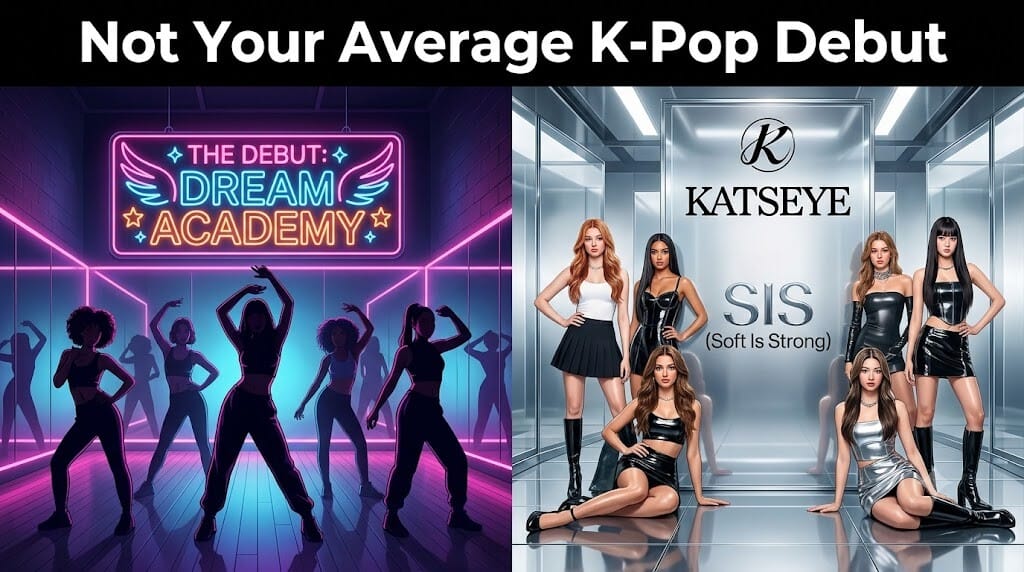
The Foundation: “The Debut: Dream Academy”
The most significant divergence from a traditional K-pop debut is how KATSEYE was introduced to the public long before they even had a name. While survival shows are common in South Korea (think Produce 101 or I-LAND), the scale and scope of The Debut: Dream Academy were entirely different.
A Global Audition Process
Traditional K-pop agencies hold global auditions, but the focus is often heavily skewed towards East Asian talent who will ultimately relocate to Seoul and train in relative secrecy. HYBE and Geffen took a different route. They announced a worldwide casting call in November 2021, receiving over 120,000 applications. The goal was explicitly to create a group that transcended national and cultural boundaries.
The resulting reality show, The Debut: Dream Academy, featured 20 contestants from incredibly diverse backgrounds, including the US, Switzerland, the Philippines, and South Korea. This wasn’t just about finding the best singers and dancers; it was about assembling a cast that reflected a truly global audience from day one.
Building an Audience Before the Music
By airing Dream Academy on YouTube over 12 weeks, HYBE and Geffen accomplished something crucial: they built an invested fanbase before the group even existed. Fans watched the contestants undergo intense, K-pop-style training and participate in performance missions. They voted on eliminations, creating a deep sense of ownership over the final lineup. In traditional K-pop, while agencies might tease trainees, the full group dynamic and individual personalities are usually revealed closer to the actual debut date. KATSEYE’s audience felt like they had built the group themselves.
The Documentary Strategy: “Pop Star Academy”
If Dream Academy was the teaser, the Netflix docuseries Pop Star Academy: KATSEYE was the main event. This is where the strategy significantly deviates from the standard K-pop playbook.
Transparency vs. Mystique
K-pop agencies historically rely on a certain level of mystique. The grueling reality of the trainee system is often downplayed to present a polished, perfect idol image upon debut. The Netflix documentary, which premiered in August 2024, did the exact opposite. It pulled back the curtain, offering an intimate, sometimes raw look at the intense training, the emotional toll, and the internal dynamics of forming the group.
This level of transparency is a very Western approach to artist development. It caters to an audience that values authenticity and “behind-the-scenes” access over manufactured perfection. By chronicling the journey so explicitly on a massive global platform like Netflix, they turned the process of creating KATSEYE into a compelling narrative product in itself.
The Musical Rollout: A Western-First Approach
When it came time to actually release music, the rollout felt distinctly geared toward the US market, despite the heavy K-pop influence in the group’s formation.
The Single-Heavy EP Strategy
KATSEYE’s debut EP, SIS (Soft Is Strong), was released in August 2024. The way it was delivered, however, followed a Western pop model. They released two pre-release singles—”Debut” in June and “Touch” in July—before dropping the full EP.
While pre-release singles are becoming more common in K-pop, the traditional model often relies on a massive, singular “comeback” date where the album, the lead single, and the music video all drop simultaneously, accompanied by immediate performances on Korean music shows. KATSEYE’s strategy allowed them to build momentum more gradually, letting each single breathe and find its audience on streaming platforms.
English as the Primary Language
Perhaps the most defining difference is the language. K-pop is, fundamentally, Korean popular music. Even as groups release English singles, their core discography remains in Korean. KATSEYE, however, operates primarily in English. Their music targets the global pop market first and foremost.
This language choice firmly positions them outside the strict definition of “K-pop” and into the realm of a “Global Pop Group.” They are using the K-pop training system to create artists who can compete directly with Western pop stars on their own turf, in their own language.
The Blended Promotional Circuit
While their base of operations is Los Angeles and their strategy is Western-focused, KATSEYE didn’t entirely abandon the K-pop promotional machine.
They have appeared on major South Korean music broadcast shows like M Countdown and Music Bank. This is a fascinating hybrid approach. By performing on these traditional K-pop platforms, they validate their status to K-pop fans—proving they have the synchronization and professionalism expected of idols—while simultaneously promoting an English-language, Western-targeted project. It’s a foot in both worlds.
Writer’s Opinion
So, they basically took the K-pop boot camp, put it on Netflix, and targeted the Billboard charts instead of Melon. It’s a brilliant, if slightly confusing, strategy. HYBE and Geffen are essentially trying to have their cake and eat it too—they want the rabid, organized fandoms of K-pop, but the broad, mainstream appeal of Western pop. Honestly, the fact that they managed to blend the intense secrecy of the K-pop trainee system with the over-sharing reality TV culture of the West is wild. It makes you wonder if this is the new blueprint for all future pop groups, or just a highly expensive one-off experiment. Either way, it’s working.